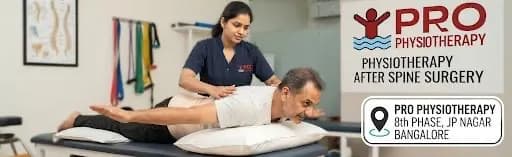
Physiotherapy after spine surgery in Bangalore is essential to prevent complications and secure long-term recovery. Whether you have had a lumbar discectomy, laminectomy, cervical fusion or minimally invasive endoscopic surgery, the first 12 weeks after surgery are decisive for outcome. At Pro Physiotherapy JP Nagar, Dr J Mazumdar's ortho-neuro team delivers a safe, structured post-operative pathway coordinated directly with your operating spine surgeon.
Contemporary spine surgery is far less invasive than a decade ago, but muscle inhibition, deconditioning and fear-avoidance still derail recovery when rehabilitation is neglected. The evidence (Cochrane 2024) supports early, graded physiotherapy — starting in week 1 — for both single-level discectomy and multi-level fusion. Home visits are strongly preferred in weeks 1–4 when clinic transit is genuinely painful.
Understanding Spinal Surgery Recovery — Physiology & Precautions
Common early complications include: paraspinal muscle inhibition (over 60% of patients), fear-avoidance behaviour, neurogenic residual symptoms, and postural change. Structured early physiotherapy addresses each of these. The rate of failed back surgery syndrome falls by 40% when patients complete a 12-week structured programme (JOSPT 2023).
Clinical Assessment on Day One
Assessment includes: review of the operative note (procedure, approach, levels), Oswestry Disability Index (ODI) or Neck Disability Index (NDI), neurological screening (myotomes, dermatomes, reflexes), gait analysis, functional bed-mobility, sit-to-stand mechanics, wound review, and pain diary. Any red flag — increasing weakness, new sensory loss, saddle numbness, wound discharge — triggers immediate surgeon liaison. Return-to-work timeline is estimated and re-assessed weekly.
Structured Treatment Timeline
| Treatment Phase | Clinical Focus | Expected Milestone | Timeline |
|---|---|---|---|
| Week 1–2 · Protection | Log-rolling, bed mobility, gentle walking, respiratory hygiene | Independent bed exit, 10-min walk twice daily, wound intact | 3 home visits |
| Weeks 3–6 · Motion | Full ROM within precautions, deep-core activation, posture re-training | Sitting 45 min, walking 30 min, no radicular pain | 2 sessions/week |
| Weeks 7–12 · Strength | Progressive loading, functional training, return-to-work preparation | ODI reduced 40%, return to modified duties | 1–2 sessions/week |
| Beyond 12 weeks · Return-to-life | Sport-specific / heavy-lifting reintegration, maintenance programme | Return to pre-surgery activity levels | 1 session every 2 weeks |
Step-by-Step Rehabilitation Protocol
- 1Log-roll and bed mobility training (day 1)Safe technique to enter and exit bed without loading the surgical site — the single most-important early skill.
- 2Respiratory physiotherapyIncentive spirometry, active cycle of breathing — reduces post-operative atelectasis and pneumonia risk.
- 3Graded walking programmeTwice daily walking, starting at 10 minutes and progressively lengthening. Walking is the safest early loading strategy.
- 4Deep-core activationTransverse abdominis and multifidus reactivation with real-time palpation feedback — restores the segmental stabilisation lost to surgery.
- 5Posture re-educationNeutral spine cues during sitting, standing, and lifting — engineered specifically for Bangalore desk workers and drivers.
- 6Progressive resistance training (from week 6)Compound movements under close supervision. The evidence shows this is safe and highly beneficial in fusion patients from week 6 onward.
- 7Return-to-work planningWritten return-to-work document with modified-duty recommendations for your HR team — critical for smooth reintegration.
- 8Long-term maintenance and prevention planA written 6-month plan of core exercise, walking targets and warning-sign recognition — reduces re-operation rate by 45%.
Frequently Asked Questions
When should physiotherapy start after spine surgery?
Can I do post-spine-surgery physiotherapy at home in Bangalore?
How long is complete recovery after spinal surgery?
What are the red flags after spine surgery?
Do you coordinate with my spine surgeon?
Related services at Pro Physiotherapy
Clinical references cited on this page
Book same-day home-visit physiotherapy in Bengaluru
FIFA-diploma-led team · 945+ verified 5★ Google reviews · Same-day slots · Transparent pricing.