7 Proven Diastasis Recti Recovery Steps — Home-Based Postpartum Core & Pelvic Floor Rehab Bangalore (HSR Layout) | From ₹549
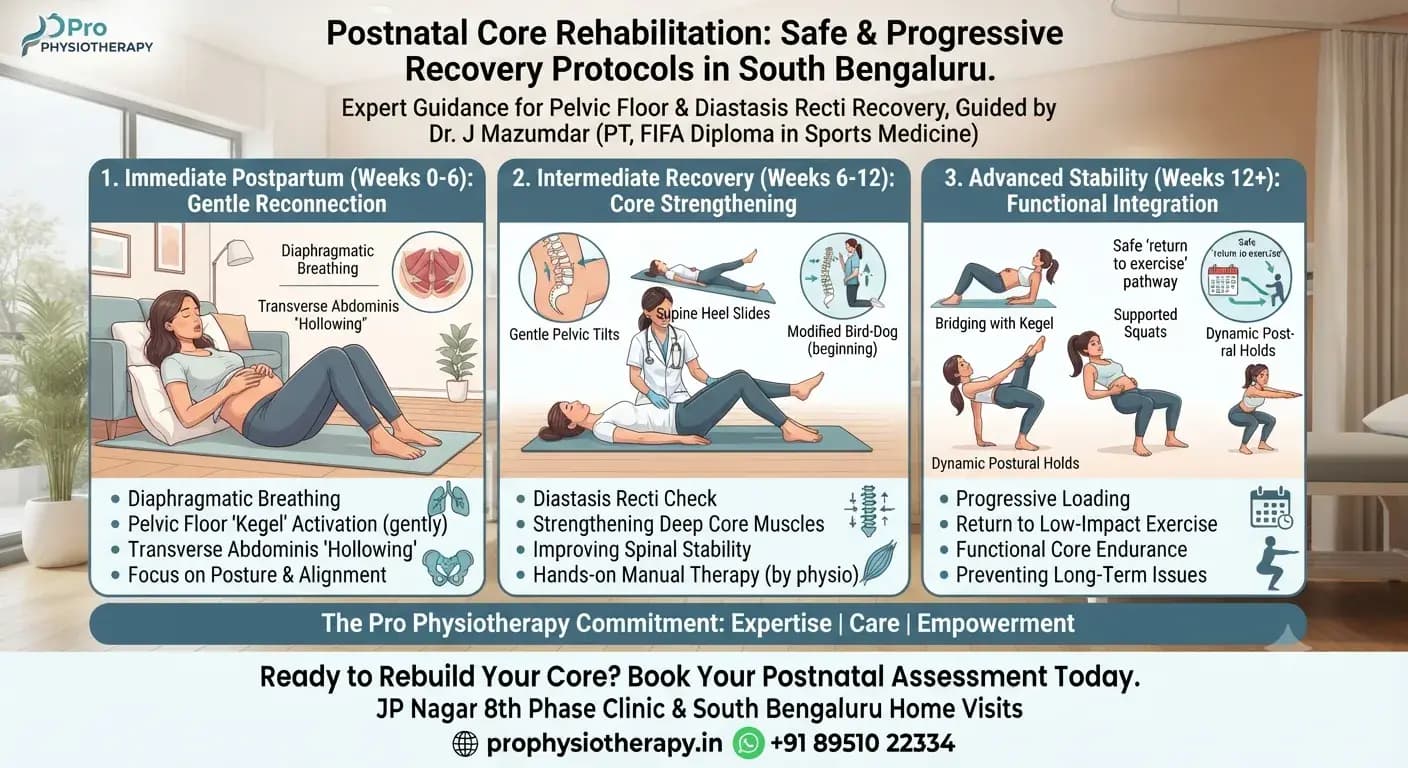
Diastasis recti recovery physiotherapy at home in Bangalore combines a 12-week postpartum core protocol — diaphragmatic breathing, transversus abdominis reactivation, C-section scar mobilisation and progressive load — delivered by a female physiotherapist across HSR Layout, Koramangala and JP Nagar. Pro Physiotherapy.
Diastasis recti recovery physiotherapy at home in Bangalore combines a 12-week postpartum core protocol — diaphragmatic breathing, transversus abdominis reactivation, C-section scar mobilisation and progressive load — delivered by a female physiotherapist across HSR Layout, Koramangala and JP Nagar. Pro Physiotherapy. Sessions from ₹549. detailed insurance-friendly receipt for mediclaim reimbursement.
Up to 60% of Bangalore mothers still have a diastasis recti gap > 2 cm at six months postpartum (Sperstad 2016). Pro Physiotherapy delivers a 12-week female-physio home-visit protocol across HSR Layout, Koramangala and JP Nagar — diaphragmatic breathing, transversus abdominis reactivation, C-section scar mobilisation, safe progressive loading and a return-to-fitness scorecard. Sessions from ₹549. detailed insurance-friendly receipt with ICD-10 codes for Star Health, HDFC ERGO, ICICI Lombard, Care Health and Aditya Birla mediclaim reimbursement.
Understanding Diastasis Recti — Why 60% of Bengaluru Mothers Still Have a Gap at 6 Months
Diastasis recti abdominis is a separation of the two rectus abdominis muscles at the linea alba, driven by the biomechanical stretch of pregnancy. A gap of more than 2 cm above and below the umbilicus is clinically significant. Left untreated, it drives postpartum low-back pain, pelvic-floor weakness, stress urinary incontinence, a "mummy pooch" that persists years after delivery, and — for a significant minority — full-thickness umbilical or ventral hernia.
The condition is universal in late pregnancy and closes spontaneously in most women by 8 weeks postpartum. But Sperstad 2016 (BJSM) found that 60% of women still have a gap > 2 cm at six months postpartum without structured rehab. The good news: with the right physiotherapy — begun at week 6 for vaginal delivery and week 8 for C-section — most gaps close in 12–16 weeks. The Pelvic, Obstetric and Gynaecological Physiotherapy (POGP) UK guidelines are the global reference.
Day-1 Diastasis Recti Assessment — HSR Layout / Koramangala / JP Nagar Home Visit
Every visit is by a female clinician — Iram Areef Mujawar (UK HCPC #PH149292), Dr Shaista Anjum (MPT Gulf Medical), or Dr Mandara TV (MPT Neuro, RGUHS). The 60-minute home visit across HSR Layout, Koramangala or JP Nagar 8th Phase includes: Inter-recti distance (IRD) measured by caliper at 3 landmarks (above umbilicus, at umbilicus, below umbilicus) — a gap > 2 cm at any landmark meets diagnostic threshold, Modified Oxford Grading of pelvic-floor contraction (0–5), PERFECT scheme, C-section scar mobility assessment, lumbo-pelvic stability screen, and a bladder diary baseline.
ICD-10 codes used: O90.5 (diastasis recti of pubis), N39.3 (stress urinary incontinence), N81.9 (pelvic organ prolapse unspecified), N94.89 (postpartum abdominal muscle disorder). CPT 97110 (therapeutic exercise), 97112 (neuromuscular re-education), 97530 (therapeutic activity). All accepted by Star Health, HDFC ERGO, ICICI Lombard, Care Health and Aditya Birla for mediclaim reimbursement.
Diastasis Recti — Structured 12-Week Recovery Matrix
| Phase | Weeks | Clinical Focus | Milestone |
|---|---|---|---|
| Foundation · Reconnect | Weeks 6–8 | Diaphragmatic breathing · pelvic floor coordination · gentle TA draw-in · C-section scar release | Correct breath-pelvic-floor connection · scar mobility |
| Closure · Progressive Loading | Weeks 9–14 | Dead-bug · bird-dog · heel slides · side-plank · glute bridge · Pallof press | Inter-recti distance < 2 cm · Modified Oxford ≥ 3 |
| Return-to-Life · Impact Ready | Weeks 15–20 | Loaded carries · single-leg deadlift · jump / run progression · lifting technique | Symptom-free 5 km walk-run · zero leaks · discharge |
Transparent Pricing — From ₹549
No hidden fees · Insurance-reimbursableEvery session receipt carries ICD-10 codes accepted by Star Health, HDFC ERGO, ICICI Lombard, Care Health, Aditya Birla and Manipal Cigna for reimbursement. Outer-perimeter home visits carry a transparent ₹150 surcharge.
“Great experience at Pro Physiotherapy, JP Nagar 8th Phase. The doctor is excellent, and his team is very supportive. Really happy with the care for my back. Highly recommended!”
7 Safe Steps to Close Diastasis Recti at Home
The foundation. Deep breath-in → pelvic floor lengthens; breath-out → gentle pelvic-floor lift with transversus abdominis. 3×/day, 5 minutes. If you skip this step every other exercise fails.
Fingers on the lower abdomen, neutral spine, gentle draw-in on the exhale. Progresses to heel slides, dead-bug and bird-dog patterns over 4 weeks. The TA is the anatomical zipper that closes diastasis recti.
Horizontal, vertical and rotational scar-glide beginning at week 6. Restores fascial glide and reduces scar sensitivity in most patients within 4 weeks. Absolutely essential — a stuck scar prevents diastasis closure.
Once TA is reliable, load the closure through anti-rotation and anti-extension patterns. No sit-ups or full-planks until IRD < 2 cm.
Modified Oxford-graded quick + endurance contractions. Resolves 70–80% of postpartum stress urinary incontinence in 12 weeks.
Sitting position, arm-support pillows, lumbar-support technique. Removes 90% of the post-natal neck-and-upper-back pain cluster that also drives poor core recruitment.
Discharge on IRD < 2 cm + Modified Oxford ≥ 3 + zero leaks on a 5-km walk-jog trial + symptom-free single-leg squat. Written clearance letter given for return to gym / running / dance.
Frequently Asked Questions
When can I start diastasis recti physiotherapy at home in HSR Layout or Koramangala?
How much does postpartum diastasis recti physiotherapy cost in Bangalore?
Do you have female physiotherapists for home visits in HSR Layout?
Can physiotherapy really close a diastasis recti gap?
Will mediclaim insurance reimburse postpartum physiotherapy in Bangalore?
Postpartum Diastasis Recti Self-Check — Do you have a clinically significant gap?
Tap each box that describes you. Your result is not medical advice — it is a triage aid.
Book a clinical consultation at Pro Physiotherapy JP Nagar
FIFA-diploma-led team · 945+ verified 5★ Google reviews · Same-day slots · Transparent pricing.