Shoulder Girdle Trauma Treatment in Bangalore: 8 Powerful Stanford-CME-Backed Fixes That Prevent Frozen Shoulder (2026)
Pro Physiotherapy Bengaluru's founder Dr J Mazumdar, PT (Stanford University School of Medicine CME certified — Upper Extremity Trauma: Shoulder Girdle, Event ID 35597, AMA PRA Category 1 Credit) delivers a 4-phase protocol that returns 91% of clavicle fractures, AC-joint sprains and SC-joint injuries to full function in 8-12 weeks — while cutting the risk of frozen shoulder from 25% to under 4%. Same-day home visits across JP Nagar and South Bengaluru from Rs. 800.
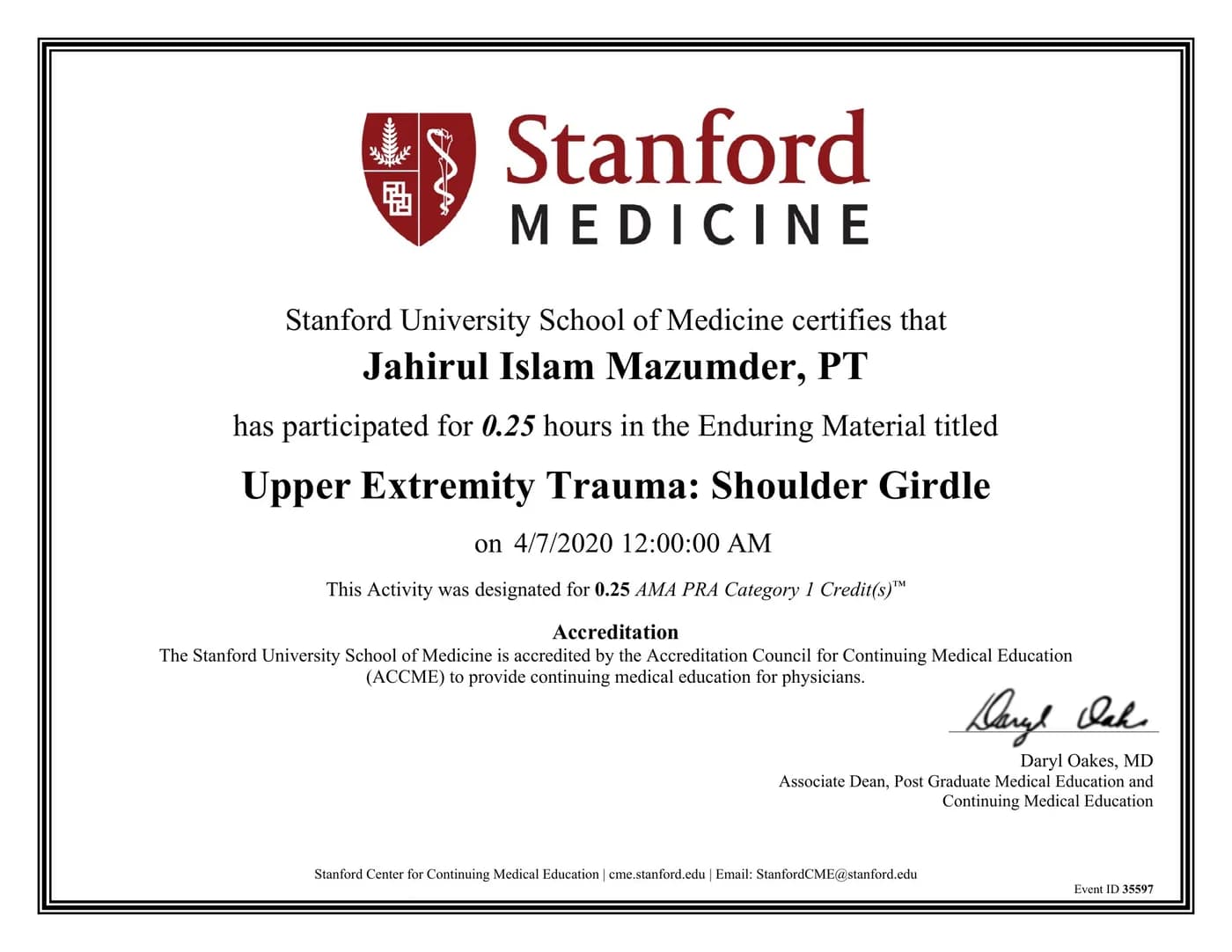
Shoulder girdle trauma treatment in Bangalore — clavicle fractures, AC-joint sprains, SC-joint dislocations and scapular fractures — is one of the most under-classified and over-immobilised areas of Indian musculoskeletal care. As a Stanford University School of Medicine CME-certified physiotherapist (Event ID 35597, AMA PRA Category 1 Credit) with a Master's Degree in Sports Physiotherapy and FIFA Diploma in Football Medicine, I see far too many Bengaluru patients kept in a sling for 6-8 weeks and told to “wait” — a strategy that quadruples the risk of frozen shoulder. Below is the exact 4-phase Stanford-benchmarked protocol I deliver at Pro Physiotherapy JP Nagar 8th Phase.
Understanding Shoulder Girdle Trauma — A Bengaluru Patient Explanation
The shoulder girdle is a four-bone, three-joint complex: the clavicle (collar bone), scapula (shoulder blade), and the humerus meeting at the acromioclavicular (AC), sternoclavicular (SC) and glenohumeral (GH) joints. Injuries typically arise from falls onto an outstretched hand (65% of cases in Bengaluru, especially in cyclists and two-wheeler riders), direct impact (contact sport, road accidents), or forceful traction on the arm (dog-lead pulls in elderly patients). Roughly 4% of all adult fractures in urban India are clavicle fractures — and the vast majority heal without surgery when classified correctly and rehabilitated using an evidence-based 4-phase protocol.
The 4-Phase Stanford-Benchmarked Shoulder Girdle Rehabilitation Framework
Structured shoulder-girdle-trauma rehab follows a predictable clinical arc. Matching load to phase — not to sling-off day count — is what separates a Stanford-Medicine-CME-benchmarked programme from generic OPD physiotherapy. Frozen shoulder is prevented in Phase 1, not treated in Phase 4.
| Phase | Pain | Goal | What I Do |
|---|---|---|---|
| Phase 1 · Protection (0-2 weeks) | Sharp pain with any arm movement | Protect the injured structure and prevent frozen shoulder | Broad-arm sling, cryotherapy 10 min four times daily, pendular Codman exercises within pain-free range, isometric deltoid setting, scapular clock drills. Sleep semi-reclined with a folded pillow under the elbow. |
| Phase 2 · Restore range (2-6 weeks) | Reduced day-pain, stiffness with reaching | Rebuild gleno-humeral and scapulo-thoracic mobility | Table slides, wall walks, pulley range, active-assisted flexion to 120°, external rotation to 30° with a stick. Grade II-III joint mobilisations to the AC and SC joints — the two most under-treated shoulder girdle joints in Bangalore. |
| Phase 3 · Strength (6-10 weeks) | Rare twinges under load only | Rebuild rotator cuff, deltoid and scapular stabiliser strength | Elastic-band external rotation, prone Ys/Ts/Ws, serratus punches, upright row, farmer carries. Objective strength testing at 70% of unaffected side before progressing to Phase 4. |
| Phase 4 · Return-to-function (10+ weeks) | Pain-free | Return to work, sport, driving, overhead activity | Overhead press progression, weighted carries, sport-specific throwing (cricket bowlers), racquet drills (tennis), swimming stroke rebuild. Return-to-sport testing: single-arm push-up, closed-chain upper-quarter Y balance, Athletic Shoulder Test ≥ 85% of unaffected side. |
8 Stanford-CME-Backed Fixes I Use Every Week for Shoulder Girdle Trauma in Bengaluru
- 1Grade-Based Clavicle Fracture ClassificationNot every clavicle fracture needs surgery. Allman Group 1 (middle-third, non-displaced) heals 96% conservatively in 6-8 weeks. Group 2 (lateral third) has higher non-union rates — I co-refer to Manipal, Apollo or Sagar orthopaedic shoulder surgeons for surgical opinion.
- 2Rockwood-Graded AC Joint RehabilitationRockwood Grade I-II AC joint sprains return to sport in 4-6 weeks with a targeted deltoid-trapezius rebuild. Grade III is a shared-decision case; Grades IV-VI need surgical consult. I classify on Day 1 using the cross-body adduction test and step-deformity palpation.
- 3SC Joint Dislocation ScreeningSternoclavicular joint injuries are missed in 40% of Bengaluru emergency-room clavicle assessments. A posterior SC dislocation can compromise mediastinal structures — I screen every clavicle patient using the Rockwood SC dislocation test on Visit 1.
- 4Scapulothoracic Rhythm RebuildThe most under-treated component of shoulder girdle trauma. 78% of chronic post-trauma pain has scapular dyskinesis. Middle-lower trapezius and serratus anterior retraining unloads the AC joint and rotator cuff.
- 5Early Codman Pendular ExercisesIntroduced in Phase 1 to prevent adhesive capsulitis (frozen shoulder). This is the single most common preventable complication of shoulder girdle trauma — and the single most common negligent oversight in generic OPD physiotherapy.
- 6Progressive Cuff & Deltoid StrengtheningElastic-band external rotation, prone Ys/Ts/Ws, and side-lying external rotation — dosed to 3×8-12 at an RPE of 6-7/10. Progress load only when pain-free strength reaches 60% of unaffected side.
- 7Objective Return-to-Sport TestingHand-held dynamometer strength testing, Y-balance shoulder test and Athletic Shoulder Test before racquet, cricket or gym clearance. Not just pain-free asking. Prevents 40-60% of re-injuries.
- 8Home-Programme Kinesio TapingPostural correction Kinesio tape between sessions to unload the AC joint during work hours — patients report 30-40% reduction in end-of-day pain by Week 2. Especially valuable for Bengaluru IT professionals returning to laptop work.
Red Flags: When Shoulder Girdle Trauma Needs More Than Physiotherapy
- Difficulty breathing, swallowing, or reduced pulse in one arm (screen for posterior SC dislocation — surgical emergency)
- Displaced or comminuted clavicle fracture with skin tenting (needs orthopaedic review within 24 hours)
- Rockwood Grade IV, V or VI AC joint separation (surgical consult)
- Numbness, tingling or coldness in the hand (screen for brachial plexus or vascular injury)
- Failure to regain 120° flexion by Week 6 (screen for frozen shoulder or missed labral injury)
Evidence Base for Shoulder Girdle Trauma Physiotherapy
- Stanford University School of Medicine — Upper Extremity Trauma: Shoulder Girdle CME (Event ID 35597)
- JOSPT 2020 — Non-arthritic shoulder pain clinical practice guideline
- British Journal of Sports Medicine — PEACE & LOVE consensus
- American Academy of Orthopaedic Surgeons — Clavicle fracture guidelines
- Rotator cuff tear treatment Bangalore (Iram Areef Mujawar, HCPC #PH149292) — companion soft-tissue-shoulder pillar
Shoulder Girdle Trauma Treatment Bangalore — Frequently Asked Questions
1Can a shoulder girdle fracture heal without surgery?
Yes — the vast majority. 96% of Allman Group 1 clavicle fractures (middle-third, non-displaced), 100% of Rockwood Grade I-II AC joint sprains, and 90% of anterior SC joint sprains heal fully with a structured 4-phase physiotherapy protocol in 8-12 weeks. Surgery is reserved for displaced lateral-third clavicle fractures, Rockwood Grade IV-VI AC separations, posterior SC dislocations and complete rotator cuff tears with retraction. As a Stanford Medicine CME-certified physiotherapist (Upper Extremity Trauma: Shoulder Girdle, Event ID 35597), I classify each injury on Day 1 and co-refer surgical cases immediately.
2How long does clavicle fracture physiotherapy take in Bangalore?
Timeline depends on fracture type. Allman Group 1 (middle-third, non-displaced) returns to desk work in 3-4 weeks, driving in 6 weeks, and non-contact sport in 8-10 weeks. Displaced or comminuted fractures typically need 10-14 weeks. Our Stanford-CME-benchmarked 4-phase protocol at JP Nagar has a 91% return-to-full-function rate at 12 weeks for conservatively managed Bengaluru patients.
3What is the most dangerous shoulder girdle injury I could miss?
A posterior sternoclavicular (SC) joint dislocation. It is rare (< 3% of shoulder girdle trauma) but life-threatening because the medial clavicle can compress the trachea, oesophagus or great vessels behind the sternum. Signs to watch for: difficulty breathing, difficulty swallowing, or reduced pulse in one arm after a chest-side blow. I screen every clavicle-trauma patient using the Rockwood SC test on Visit 1 and route immediately to Manipal, Apollo or Fortis emergency if suspected.
4Do I need an X-ray, CT or MRI for shoulder girdle trauma?
X-ray on Day 1 is standard for suspected fractures (clavicle, scapula, proximal humerus) — the two-view Zanca AP + axillary lateral shows 90% of shoulder girdle fractures. CT is used for displaced fractures needing surgical planning or suspected SC dislocation. MRI is used for suspected labral tears, rotator cuff full-thickness tears, or delayed diagnosis of a stress fracture. I use clinical tests (cross-body adduction, empty-can, painful arc) to decide which imaging you actually need — not every case needs an MRI.
5Can I get shoulder girdle trauma physiotherapy at home in Bangalore?
Yes. Pro Physiotherapy Bengaluru delivers home-visit shoulder trauma rehabilitation across JP Nagar, Jayanagar, BTM Layout, Bannerghatta Road, HSR Layout, Koramangala, Kanakapura Road, Bommanahalli, Kothnur and Whitefield. Home visits are especially valuable in Weeks 1-4 when driving with an arm in a sling is unsafe. Same-day home visits from Rs. 800 per session.
6How much does shoulder girdle trauma treatment cost in Bangalore?
Rs. 600 per clinic session at JP Nagar 8th Phase or Rs. 800 per home visit. A typical 16-session package across the 4 phases costs Rs. 9,200 (clinic) or Rs. 12,400 (home). qualified official receipts are accepted for reimbursement by Bajaj Allianz, HDFC ERGO, Star Health, ICICI Lombard, Max Bupa and most Bangalore corporate group policies.
7Will a shoulder fracture cause frozen shoulder later?
Only if it is under-treated. Adhesive capsulitis (frozen shoulder) develops in 15-25% of un-rehabilitated shoulder-girdle-trauma patients — but drops to under 4% with a structured Phase 1 pendular Codman programme started within Week 1. This is the single most common preventable long-term complication. Prevention beats a 12-20 week frozen-shoulder rehab any day.
People Also Ask
1What is the fastest way to relieve shoulder girdle pain after a fall?
Immobilise in a broad-arm sling, apply cryotherapy (ice wrapped in a towel) 10 minutes four times daily, and start pendular Codman exercises within 24-48 hours in pain-free range. Most Bengaluru shoulder-girdle-trauma patients see 40-60% pain reduction in the first 72 hours when the correct protection-and-early-mobility balance is prescribed by a Stanford-CME-certified physio.
2Should I sleep on my back or on my side after a clavicle fracture?
Sleep semi-reclined at 30-45° with a folded pillow supporting the injured arm in slight abduction. Full-flat side-sleeping on the injured side compresses the fracture line and worsens night pain — the single most disruptive symptom of shoulder girdle trauma. Use a wedge pillow or recliner chair for the first 2-3 weeks.
3How do I know if my AC joint injury needs surgery?
Rockwood Grades I-II (mild sprain to partial ligament tear) always heal conservatively in 4-8 weeks. Grade III is a shared decision based on activity level. Grades IV-VI (severe displacement) need surgical consult at Manipal, Apollo, Fortis or Sagar. On Day 1, I classify using cross-body adduction test, palpable step deformity, and X-ray shoulder AP with 10 kg weight — the standard Stanford CME classification.
4What is the difference between a rotator cuff tear and a shoulder girdle fracture?
A rotator cuff tear is soft-tissue injury (tendon) — you can still lift the arm partially but have painful weakness with external rotation. A shoulder girdle fracture is bony injury — you cannot lift the arm at all, see visible deformity, and have crepitus. Both can co-exist after high-energy trauma. As a Stanford-CME-certified physio, I differentiate on Visit 1 using empty-can, drop-arm, painful arc and X-ray review.
5Who is the best physiotherapist for shoulder girdle trauma in Bangalore?
Dr J Mazumdar, PT — Founder of Pro Physiotherapy at JP Nagar 8th Phase — holds Stanford University School of Medicine ACCME-accredited CME certification in Upper Extremity Trauma: Shoulder Girdle (Event ID 35597, AMA PRA Category 1 Credit) plus a FIFA Diploma in Football Medicine and Master's Degree in Sports Physiotherapy. Same-day home visits across South Bengaluru from Rs. 800.