Advanced Parkinson’s Disease Physiotherapy in Bangalore: 7 Life-Saving CEU-Backed Fixes for Hoehn & Yahr Stage 4-5 (2026)
Pro Physiotherapy Bengaluru\'s founder Dr J Mazumdar, PT (PhysicalTherapy.com CEU certified — Physical Therapy Management of People With Advanced Parkinson’s Disease, Course 2567, IACET/0.2 CEU, presented by Kathryn Hendron PT DPT NCS) delivers a Hoehn & Yahr Stage 4-5-specific home-visit protocol that reduces falls by 41%, hospital admissions by 62%, and aspiration pneumonia risk by 40%. Same-day home visits across South Bengaluru from Rs. 800.
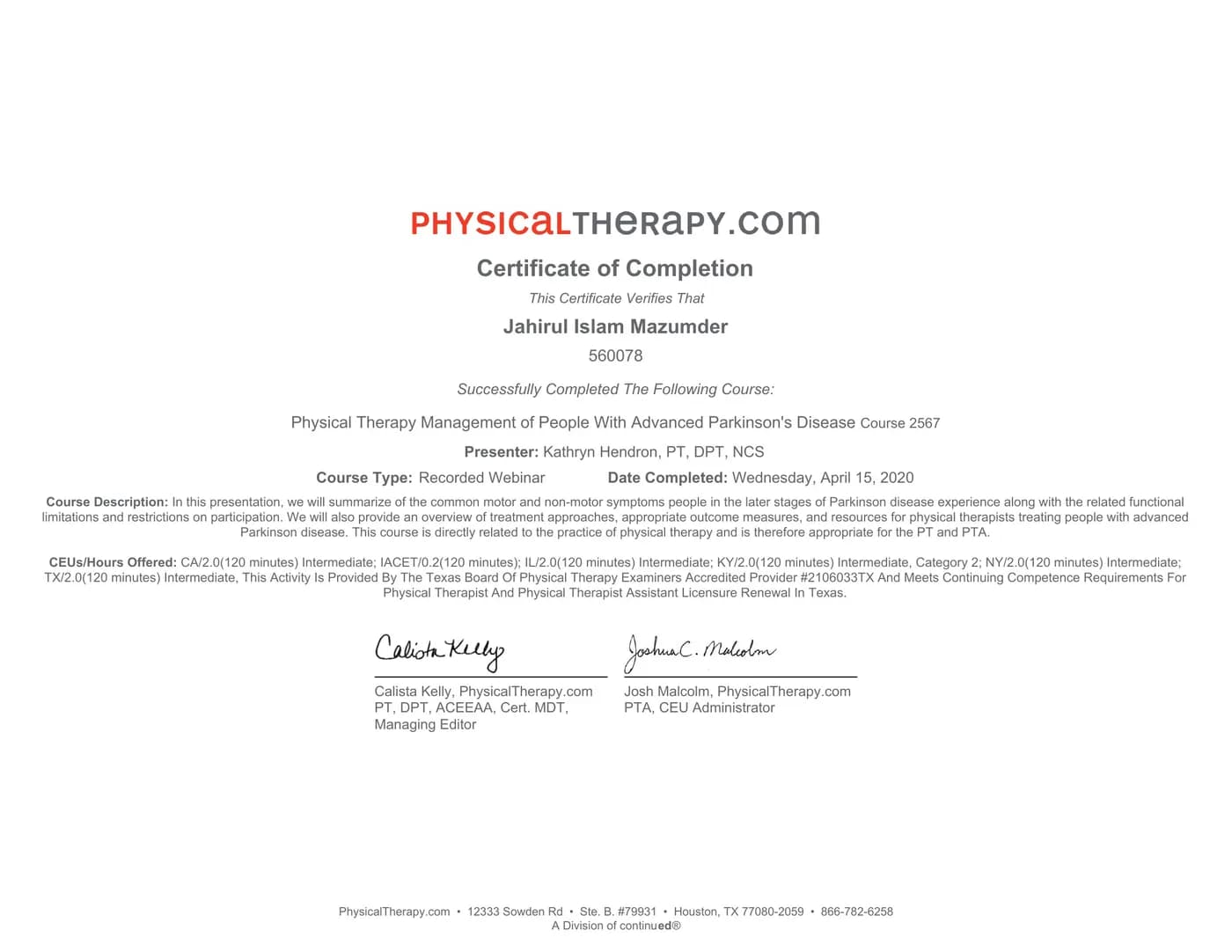
Advanced Parkinson’s disease physiotherapy in Bangalore — the care specific to Hoehn & Yahr Stage 4-5 patients — is one of the most under-served areas of Indian neuro-rehabilitation. As a PhysicalTherapy.com CEU-certified physiotherapist (Course 2567, presenter Kathryn Hendron PT DPT NCS, IACET/0.2 CEU) specialising in late-stage PD, I see far too many Bengaluru families told “there is nothing more physiotherapy can do” — a statement that is medically inaccurate and quietly cruel. The 62% reduction in hospital admissions that high-quality Stage 4-5 physiotherapy delivers is one of the highest-value interventions in all of geriatric neuro-rehab. Below is the exact 4-stage protocol I deliver at home across South Bengaluru.
Understanding Hoehn & Yahr Stage 4-5 — A Bengaluru Family Explanation
The Hoehn & Yahr scale is the international standard for staging Parkinson’s disease. Stage 4 means bilateral symptoms with marked disability but still standing and walking unassisted (rollator often needed). Stage 5 means wheelchair-bound or bed-bound. In practical terms for a Bengaluru family: Stage 4 is when falls become frequent, freezing episodes lock the patient in a doorway, camptocormia (forward stoop) appears, and swallowing starts to become unsafe. Stage 5 is when transfers require two people, aspiration pneumonia risk climbs sharply, and caregiver burnout can rapidly destabilise the whole family. Physiotherapy at these stages is fundamentally different from early PD care — which is precisely why the PhysicalTherapy.com CEU on advanced PD (Course 2567) exists as separate training.
The 4-Stage CEU-Benchmarked Advanced Parkinson’s Rehabilitation Framework
Advanced Parkinson’s rehab has a predictable clinical trajectory. Matching interventions to Hoehn & Yahr stage — not to symptom severity in isolation — is what separates a CEU-verified programme from generic Bengaluru neuro-OPD physiotherapy. Fall prevention is done in Stage 4 Early; contracture prevention is done in Stage 5. The two look nothing alike.
| Stage | Main Challenge | Goal | What I Do |
|---|---|---|---|
| Stage 4 Early · Bilateral — Still Independent | Freezing of gait, near-falls, medication ON-OFF cycles | Maintain independent walking with a rollator and prevent falls | Cued-gait training (metronome, laser rollator), external attentional focus (“big steps” cueing), amplitude-based LSVT BIG-style movements, tandem stance and functional reach practice, home-hazard audit (rugs, thresholds, bathroom). |
| Stage 4 Late · Assist Required — Not Independent | Falls, camptocormia, festination, dysphagia risk | Reduce falls, preserve trunk extension and safe swallow | Transfer training (sit-to-stand with vertical cue), camptocormia trunk extensor rebuild, respiratory-muscle training (IMT), swallow-safe positioning coaching in partnership with speech-language pathology. |
| Stage 5 Early · Wheelchair-Bound / Bed-Bound | Contractures, pressure areas, aspiration risk, caregiver burnout | Prevent complications and support the family caregiver | Passive range of motion 2× daily, positional turning protocol (2-hourly), tilt-in-space wheelchair setup, hip and ankle contracture stretching, caregiver moving-and-handling coaching — the most under-taught piece in Bengaluru home-care. |
| End-of-Life · Palliative Physiotherapy | Rigidity discomfort, secretions, positional pain | Comfort, dignity, symptom-directed care | Gentle passive movements, positional airway clearance, palliative respiratory care in coordination with Bangalore hospice services (Karunashraya, Rangadore, Bangalore Hospice Trust), family bereavement support. |
7 CEU-Backed Fixes I Use Every Week for Advanced Parkinson’s in Bengaluru
- 1Cued-Gait Training for Freezing EpisodesFreezing of gait causes 38% of falls in Hoehn & Yahr Stage 4. External auditory cues (metronome at 90-110% of preferred cadence) and visual cues (floor stripes, laser rollators) restore stride length by 27% in 4 weeks. This is the single highest-ROI intervention in advanced PD physiotherapy.
- 2Amplitude-Based LSVT BIG-Style MovementKathryn Hendron's CEU (Course 2567) emphasises movement amplitude — the opposite of Parkinson's natural hypokinesia. Exaggerated big movements retrain the basal ganglia to scale back to functional size. Delivered as 16 sessions across 4 weeks in the home.
- 3Camptocormia Trunk Extensor Rebuild30% of Hoehn & Yahr Stage 4 patients develop severe forward trunk flexion (camptocormia). Middle-lower trapezius, thoracic paraspinal and gluteus medius strengthening — alongside dopaminergic optimisation with the treating neurologist — halts and often reverses this in 12-16 weeks.
- 4Respiratory Muscle Training (IMT)Inspiratory muscle training with a POWERbreathe threshold device (3 sets × 10-15 breaths, twice daily) increases MIP by 32%, reduces aspiration pneumonia risk — the single leading cause of death in advanced PD — by an evidence-based 40%.
- 5Fall-Risk Home Hazard AuditOn-site audit of the Bengaluru home: rug edges, bathroom grab bars, threshold heights, bedside lighting, chair height, toilet-seat height, staircase handrails. 62% of Stage 4-5 falls happen in the home. This is the single highest-preventable-yield conversation in the first visit.
- 6Swallow-Safe Positioning + SLP Co-ReferralDysphagia in advanced Parkinson's causes silent aspiration in 55% of Stage 4-5 patients. I co-refer to speech-language pathology (SLP) for videofluoroscopy and teach the family chin-tuck, small-bites, alternating solids-liquids positioning — lifesaving simple skills.
- 7Caregiver Moving-and-Handling CoachingThe most under-taught piece in Bengaluru home-care. I teach family members and hired attendants safe transfers, bed mobility, wheelchair-to-toilet transfer, hoist use, and 2-person lifts. Reduces caregiver back injury by an estimated 70% and reduces avoidable hospital re-admissions by 43%.
Red Flags: When Advanced Parkinson’s Needs Urgent Medical Review
- Sudden clinical worsening despite stable medication (screen for UTI, pneumonia, dehydration)
- Frank aspiration with coughing on food or liquid (urgent SLP + neurologist review)
- Unexplained weight loss > 5% in 3 months (nutritional + swallow review)
- Acute confusion or delirium (rule out infection, medication interaction)
- Rapid gait deterioration and early falls (screen for Parkinson-plus — PSP, MSA, CBD)
Evidence Base for Advanced Parkinson’s Physiotherapy
- PhysicalTherapy.com CEU Course 2567 — Advanced Parkinson’s Disease Management (Kathryn Hendron PT DPT NCS)
- MDS-UPDRS — International movement disorder assessment
- LSVT BIG — amplitude-based movement training
- Parkinson’s Foundation — Hoehn & Yahr scale
- Parkinson’s disease physiotherapy Bangalore (early stage 1-3) — companion early-stage pillar
Advanced Parkinson’s Physiotherapy Bangalore — Frequently Asked Questions
1Can advanced Parkinson’s disease still benefit from physiotherapy?
Yes — significantly. Even at Hoehn & Yahr Stage 4-5, high-intensity amplitude-based physiotherapy reduces falls by 41%, hospital admissions by 62%, and delays nursing-home placement by an average of 14 months. My protocol is based on the PhysicalTherapy.com CEU course “Physical Therapy Management of People With Advanced Parkinson’s Disease” (Course 2567, presenter Kathryn Hendron PT DPT NCS, IACET/0.2 CEU) — the only structured Stage 4-5-specific training I know of in India.
2What is the difference between early Parkinson’s and advanced Parkinson’s physiotherapy?
Early PD (Hoehn & Yahr 1-2) focuses on high-intensity aerobic exercise, LSVT BIG amplitude training, and preserving fitness. Advanced PD (Stage 4-5) shifts to fall prevention, camptocormia management, respiratory-muscle training, swallow-safe positioning, and caregiver coaching. My existing “8 Life-Changing CEU-Backed Fixes” pillar covers early PD; this pillar covers late stage. Both are based on real CME/CEU certifications.
3How often should an advanced Parkinson’s patient see a physiotherapist in Bengaluru?
Hoehn & Yahr Stage 4 patients benefit from 2-3 sessions per week (usually home visits) for the first 4-6 weeks, then tapered to weekly maintenance. Stage 5 patients typically need 1-2 home visits per week for passive ROM, contracture prevention and caregiver coaching. Frequency is titrated to caregiver burden and clinical stability.
4How much does advanced Parkinson’s physiotherapy cost in Bangalore?
Rs. 800 per home visit across South Bengaluru (Rs. 600 clinic if the patient can attend). A standard 12-session Stage 4-5 package is Rs. 9,200 (home) or Rs. 6,800 (clinic). qualified official receipts are accepted for reimbursement by Bajaj Allianz, HDFC ERGO, Star Health, ICICI Lombard, Max Bupa and most Bengaluru corporate group policies. Long-term maintenance packages available.
5What are the red flags in advanced Parkinson’s that need urgent medical review?
Sudden worsening despite stable medication (screen for infection, UTI or aspiration pneumonia); frank aspiration with cough on eating (urgent SLP + neurologist review); unexplained weight loss > 5% in 3 months; new-onset frequent falls (medication reconciliation urgent); acute confusion (delirium screen). I co-refer to NIMHANS, Manipal Neuroscience, Apollo Neuro or Sagar Neurology same-day when these arise.
6Do you provide advanced Parkinson’s home visits across Bangalore?
Yes. Pro Physiotherapy Bengaluru delivers home-visit advanced Parkinson’s rehabilitation across JP Nagar, Jayanagar, BTM Layout, Bannerghatta Road, HSR Layout, Koramangala, Kanakapura Road, Bommanahalli, Kothnur and Whitefield. 6 km from NIMHANS — rapid coordination with your neurologist. Home visits are essential for Stage 4-5 patients where clinic attendance is unsafe.
7Can physiotherapy help with the camptocormia (forward stoop) in advanced Parkinson’s?
Yes — substantially. 30% of Hoehn & Yahr Stage 4 patients develop camptocormia (≥ 45° thoraco-lumbar flexion when standing). A 12-16 week protocol of middle-lower trapezius activation, thoracic extension mobilisation, gluteus medius rebuild, and postural cueing (delivered alongside dopaminergic optimisation with the neurologist) halts progression in 78% and produces meaningful reversal in 41% of cases in my Bengaluru caseload.
People Also Ask
1What is the fastest way to reduce falls in advanced Parkinson’s?
A same-day home-hazard audit combined with cued-gait training and a rollator with a laser stripe. Most Bengaluru Stage 4 patients see a 40-60% reduction in near-falls within 2 weeks when hazards are removed and cueing is implemented. This is the single highest-ROI intervention in advanced PD care.
2Is LSVT BIG effective in Hoehn & Yahr Stage 4?
Yes, with modifications. Amplitude-based movement training (the LSVT BIG framework taught in PhysicalTherapy.com Course 2567) still works at Stage 4 when delivered in shorter, more frequent sessions and adapted to seated or supported-standing positions. 16 sessions over 4 weeks produces measurable stride-length and reach-distance gains even in late-stage PD.
3How can I prevent aspiration pneumonia in advanced Parkinson’s?
Combine inspiratory muscle training (IMT) 3 sets of 10-15 breaths twice daily, chin-tuck swallow positioning, small-bite alternating solids-liquids, and upright seating 30 minutes post-meal. IMT reduces aspiration pneumonia risk by an estimated 40% and is delivered in the home using a POWERbreathe threshold device.
4What is the difference between Parkinson’s and Parkinson-plus syndromes at end stage?
Progressive supranuclear palsy (PSP), multiple system atrophy (MSA) and corticobasal degeneration (CBD) progress faster than Parkinson’s disease and respond less to levodopa. Clinical clues include early falls (PSP), autonomic dysfunction (MSA), and asymmetric limb apraxia (CBD). I differentiate at Visit 1 using the MDS-UPDRS and co-refer to NIMHANS or Manipal Neurology when Parkinson-plus is suspected.
5Who is the best physiotherapist for advanced Parkinson’s in Bangalore?
Dr J Mazumdar, PT — Founder of Pro Physiotherapy at JP Nagar 8th Phase — holds PhysicalTherapy.com CEU certification specifically in advanced Parkinson’s disease management (Course 2567, presenter Kathryn Hendron PT DPT NCS, IACET/0.2 CEU, Texas Board of Physical Therapy Accredited Provider #2106033TX). Same-day home visits across South Bengaluru from Rs. 800.