Pediatric Physiotherapy & Developmental Delay in JP Nagar 8th Phase — Expert Play-Based Care for Worrying Torticollis, Cerebral Palsy, Gait, Flat Foot & 12+ Childhood Conditions (2026)
Pediatric physiotherapy at Pro Physiotherapy JP Nagar 8th Phase is a dedicated service for children from newborn to 16 years. Conditions treated: congenital muscular torticollis (APTA CPG Kaplan 2018 — 90% resolution with early PT), cerebral palsy across GMFCS I-V (Novak 2020 evidence-based intervention algorithm), gross motor developmental delay (early intervention per Morgan JAMA Ped 2021), idiopathic toe walking, flat foot / pes planus, gait abnormalities, W-sitting correction, and pediatric orthopedic post-op.
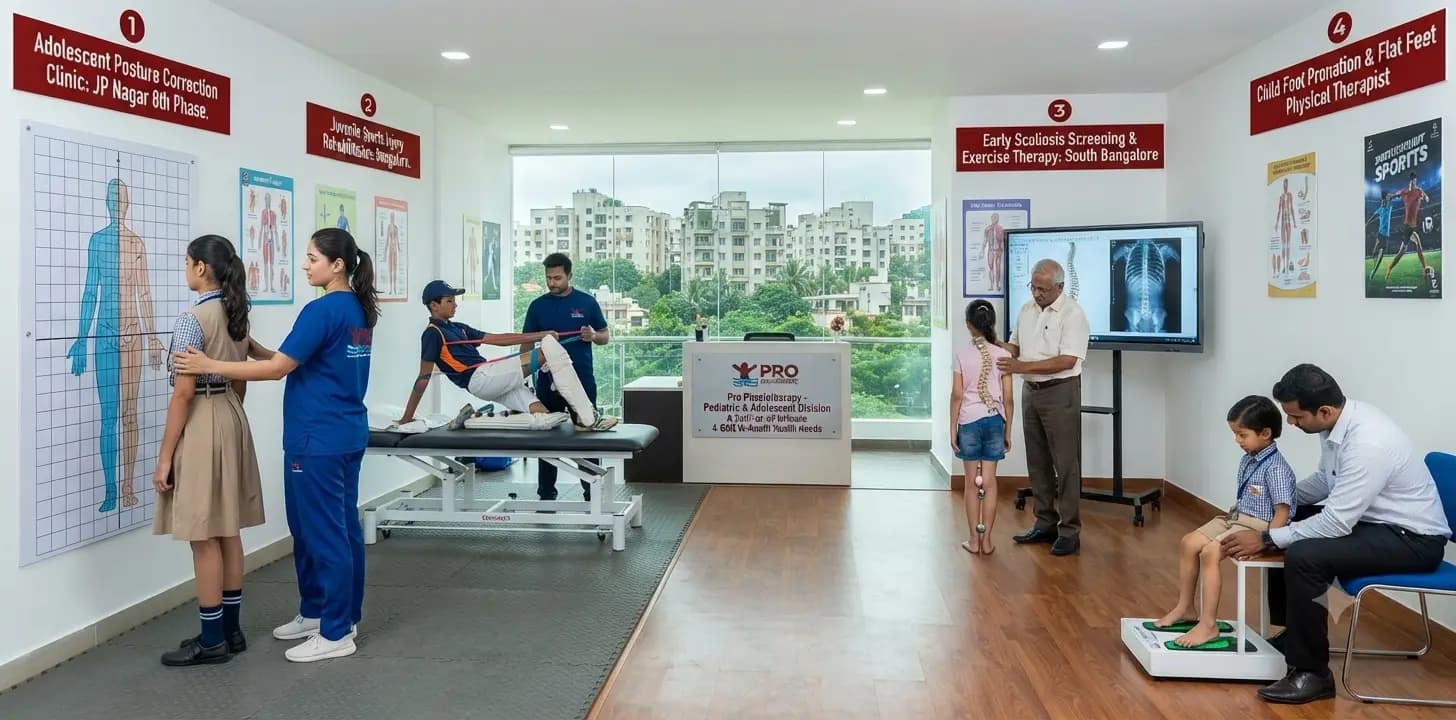
Pediatric physiotherapy at Pro Physiotherapy JP Nagar 8th Phase is a dedicated service for children from newborn to 16 years. Conditions treated: congenital muscular torticollis (APTA CPG Kaplan 2018 — 90% resolution with early PT), cerebral palsy across GMFCS I-V (Novak 2020 evidence-based intervention algorithm), gross motor developmental delay (early intervention per Morgan JAMA Ped 2021), idiopathic toe walking, flat foot / pes planus, gait abnormalities, W-sitting correction, and pediatric orthopedic post-op. Play-based sessions from ₹549 (clinic) / ₹799 (home).
Early intervention is decisive in pediatric physiotherapy. Congenital muscular torticollis has 90-95% resolution when treated before 6 months, dropping to 60% after 12 months (APTA CPG Kaplan 2018). Cerebral palsy outcomes are dramatically better with high-quality intervention before 24 months (Morgan JAMA Ped 2021). Our JP Nagar 8th Phase pediatric unit runs play-based, child-friendly sessions covering: torticollis, cerebral palsy (all GMFCS levels), gross motor developmental delay, idiopathic toe walking, flat foot, gait abnormalities, W-sitting, pediatric post-op (clubfoot, DDH). Parent-education-and-home-programme model — parents learn the therapy to run daily at home. Sessions ₹549 (clinic) / ₹799 (home).
The Pediatric Physiotherapy Milestone Framework — When to Worry, When to Refer
Worrying Milestones — When Your Child Needs a Pediatric Physiotherapy Assessment
Red-flag milestones parents should watch for: (a) Head-turn preference in newborns beyond 4 weeks → screen for congenital muscular torticollis. (b) Persistent asymmetric primitive reflexes beyond 6 months. (c) Not sitting unsupported by 9 months, not pulling to stand by 12 months, not walking by 18 months. (d) Toe walking beyond 3 years (< 3 y is often normal). (e) W-sitting exclusively beyond 4 years — indicates hip internal rotation contracture and weak external rotators. (f) Frequent tripping / clumsiness in a 4-8 y old — screen for developmental coordination disorder. Any of these warrant a pediatric physiotherapy assessment; catching them before age 3 dramatically improves outcomes.
How Pediatric Physiotherapy Sessions Actually Work — Play, Parent Coaching & Evidence
How our sessions actually work. Every session is play-based — infants get tummy-time facilitation with midline orientation toys; toddlers with CP get task-specific training disguised as obstacle courses, ball-play and rocking-horse balance; children with flat feet get barefoot texture play and short-foot activation drills; toe-walkers get eccentric calf loading with jump games. Parent coaching is 40% of the session — we teach parents 3-5 exercises to run daily at home because 20 minutes daily beats a weekly clinic-only session. For high-need cases (CP, GBS, spinal muscular atrophy) we work in tandem with pediatric neurologists at NIMHANS, Rainbow Hospital and Fortis. Novak 2020 evidence-based interventions we use: constraint-induced movement therapy (CIMT), goals-activity-motor-enrichment (GAME), context therapy, bimanual training, casting, botulinum toxin adjunct rehabilitation.
Transparent Pricing — From ₹549
No hidden fees · Insurance-reimbursableEvery session receipt carries ICD-10 codes accepted by Star Health, HDFC ERGO, ICICI Lombard, Care Health, Aditya Birla and Manipal Cigna for reimbursement. Outer-perimeter home visits carry a transparent ₹150 surcharge.
“Great experience at Pro Physiotherapy, JP Nagar 8th Phase. The doctor is excellent, and his team is very supportive. Really happy with the care for my back. Highly recommended!”
Frequently Asked Questions
When does my baby need pediatric physiotherapy for torticollis?
My toddler isn’t walking at 16 months — should I be worried?
Can physiotherapy help my child with cerebral palsy?
What about flat feet — does my child need arch supports?
My child toe-walks all the time — is this a problem?
How long does a pediatric session take?
How do I book?
Book a clinical consultation at Pro Physiotherapy JP Nagar
FIFA-diploma-led team · 945+ verified 5★ Google reviews · Same-day slots · Transparent pricing.
Clinical evidence cited in this article
- Kaplan SL, Coulter C, Sargent B (2018). Congenital muscular torticollis: physical therapy management (APTA CPG). Pediatr Phys Ther · 30(4): 240-290. https://pubmed.ncbi.nlm.nih.gov/30277962/
- Novak I, Morgan C, Fahey M, et al. (2020). Interventions for children with cerebral palsy: state of the evidence. Curr Neurol Neurosci Rep · 20: 3. https://pubmed.ncbi.nlm.nih.gov/32086598/
- Morgan C, Fetters L, Adde L, et al. (2021). Early intervention for infants at high risk of cerebral palsy: systematic review. JAMA Pediatrics · 175(8): 846-858. https://pubmed.ncbi.nlm.nih.gov/34028495/
- Ruzbarsky JJ, Scher D, Dodwell E (2016). Idiopathic toe walking: assessment and treatment. Curr Opin Pediatr · 28(1): 40-46. https://pubmed.ncbi.nlm.nih.gov/26709685/