Service Pillar · Qualified Clinicians · Insurance-Friendly

Postural Dysfunction Treatment in Bengaluru — Evidence-Based Physiotherapy for Upper-Crossed, Lower-Crossed & Forward-Head Posture

Quick Answer

Postural dysfunction is a cluster of muscle-imbalance patterns — most commonly <b>upper-crossed syndrome</b> (tight upper trapezius + pectoralis, weak deep neck flexors + rhomboids), <b>lower-crossed syndrome</b> (tight iliopsoas + erector spinae, weak abdominals + glutes), and <b>forward head posture</b>. Pro Physiotherapy Bengaluru treats it in <b>8-12 sessions</b> combining Janda muscle-length testing, Cochrane-endorsed motor-control exercise (Saragiotto 2016), DNS developmental-kinesiology drills, and an ergonomic workstation audit.
5.0 · 922+ Google reviews
Published Medically reviewed by Dr J Mazumdar, PT
JP Nagar 8th Phase from ₹549 11 min read
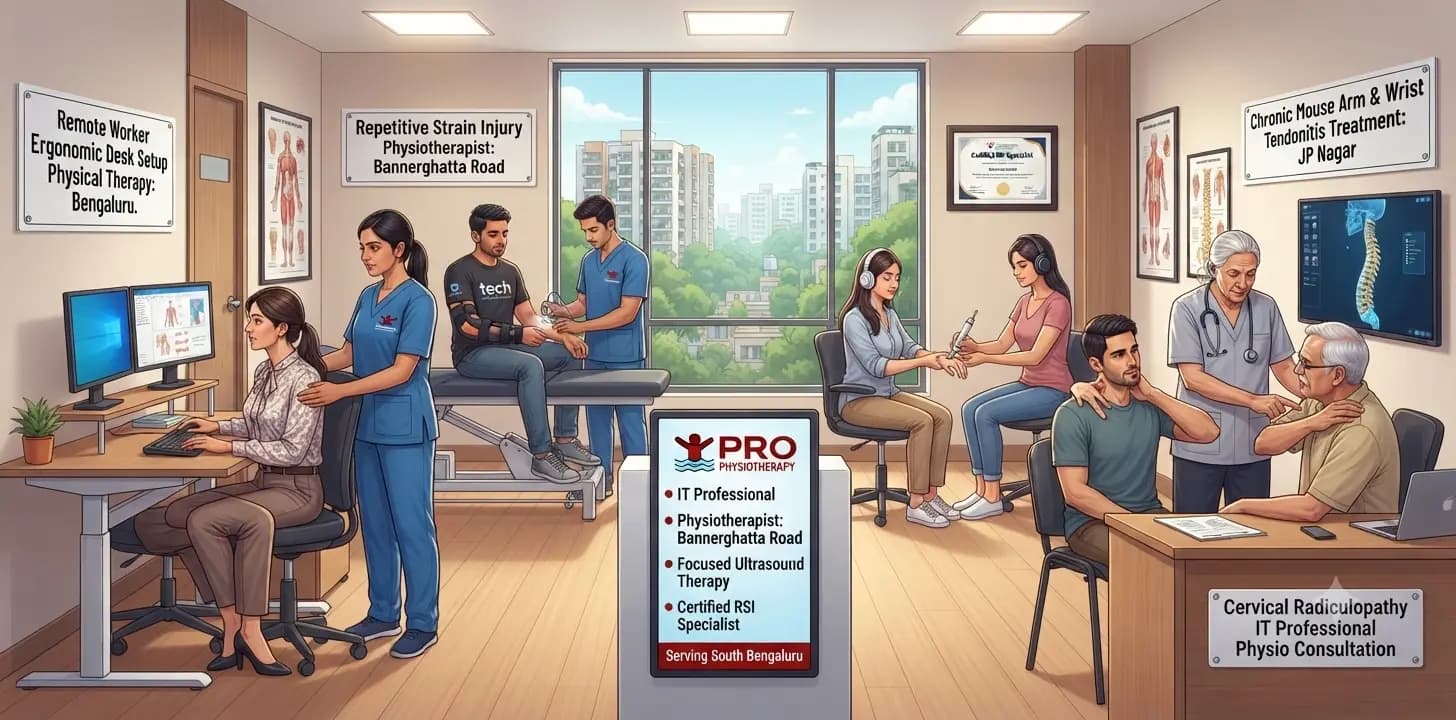
Postural dysfunction treatment Bengaluru — Pro Physiotherapy MPT-qualified physiotherapist Dr J Mazumdar assessing upper crossed syndrome forward head posture rounded shoulders thoracic hyperkyphosis and anterior pelvic tilt in a Bengaluru IT professional, using digital plumb-line analysis and Janda muscle-length testing at the JP Nagar 8th Phase clinic
Postural Dysfunction Treatment in Bengaluru — serving JP Nagar 8th Phase, Bengaluru 560076. Sessions from ₹549. detailed insurance-friendly receipt provided.
Clinical Summary · AEO / AI-Overview Ready

Postural dysfunction is a cluster of muscle-imbalance patterns — most commonly <b>upper-crossed syndrome</b> (tight upper trapezius + pectoralis, weak deep neck flexors + rhomboids), <b>lower-crossed syndrome</b> (tight iliopsoas + erector spinae, weak abdominals + glutes), and <b>forward head posture</b>. Pro Physiotherapy Bengaluru treats it in <b>8-12 sessions</b> combining Janda muscle-length testing, Cochrane-endorsed motor-control exercise (Saragiotto 2016), DNS developmental-kinesiology drills, and an ergonomic workstation audit. Assessments from ₹549 (clinic) / ₹799 (home).

TL;DR

Postural dysfunction in Bengaluru IT professionals typically presents as three overlapping patterns — upper-crossed syndrome (rounded shoulders, forward head, tight upper trap + pec, weak deep neck flexors + lower trap + rhomboids), lower-crossed syndrome (anterior pelvic tilt, tight hip flexors + erector spinae, weak abs + glutes), and pure forward head posture. Pro Physiotherapy’s 3-phase protocol — assessment → correction → reinforcement — takes 8-12 sessions and combines Janda muscle-length testing (Page 2010), Cochrane-endorsed motor-control exercise (Saragiotto 2016), DNS developmental-kinesiology drills (Kobesova 2014), and ergonomic workstation audit. Objective outcomes tracked via digital plumb-line and craniovertebral-angle photography. Assessments from ₹549 (clinic) / ₹799 (home).

The Four Postural Syndromes We Diagnose & Treat

Postural dysfunction is not one condition — it is a family of muscle-imbalance patterns that arise from prolonged asymmetric loading (long desk hours, one-sided lifting, poor sleep positions, heavy backpacks). At Pro Physiotherapy we screen for four distinct patterns. (1) Upper-Crossed Syndrome (UCS) — coined by Janda — combines tight upper trapezius, levator scapulae and pectoralis with weak deep neck flexors, rhomboids and lower trapezius. It produces the classic forward head, rounded shoulders, tension-headache presentation, and is the number-one referral we see from Bengaluru IT workers. (2) Lower-Crossed Syndrome (LCS) combines tight iliopsoas + rectus femoris + thoracolumbar erectors with weak deep abdominals + glutes, producing anterior pelvic tilt, exaggerated lumbar lordosis, and chronic low-back pain. (3) Sway-Back Posture — a distinct pattern with pelvis pushed anterior of the mid-line — produces posterior pelvic tilt with hyperextended knees. (4) Six Pocket Syndrome (Dr. J Mazumdar’s clinical framework) is a unified Bengaluru IT-worker phenotype combining elements of UCS + LCS + wallet-induced pelvic obliquity.

Our 3-phase treatment protocol is drawn from the highest-quality evidence available. Phase 1 (Assessment · sessions 1-2): Janda muscle-length testing (Ober, Thomas, Modified Thomas), craniovertebral-angle photography, Sorensen back extensor endurance, deep-neck-flexor endurance (chin-tuck), functional movement screen (SFMA). Phase 2 (Correction · sessions 3-8): manual therapy (Maitland thoracic and cervical mobilisation, myofascial release of tight structures), motor-control exercise (deep neck flexor activation, transverse abdominis + multifidus co-contraction, gluteal reactivation) per Cochrane Saragiotto 2016, and DNS developmental-kinesiology drills. Phase 3 (Reinforcement · sessions 9-12): progressive loading, sport/desk-specific integration, ergonomic workstation audit, and a written home programme.

Transparent Pricing — From ₹549

No hidden fees · Insurance-reimbursable
Clinic follow-up
₹549
30–45 min · JP Nagar 8th Phase clinic
Best if you live within 5–10 km of JP Nagar.
Home visit
₹799
60 min · at your home / office / co-working
Same-day slots across all 8 South & East Bengaluru catchments.
Day-1 assessment
₹1,500 / ₹1,800
Clinic / Home · signed 8-week plan
Full history, red-flag screen, ICD-10 receipt, printed home programme.
12-session package
₹8,900 / ₹13,500
Prepaid · saves ₹1,800 (clinic) / ₹5,100 (home)
Fortnightly progress notes for your referring doctor.

Every session receipt carries ICD-10 codes accepted by Star Health, HDFC ERGO, ICICI Lombard, Care Health, Aditya Birla and Manipal Cigna for reimbursement. Outer-perimeter home visits carry a transparent ₹150 surcharge.

Verified Google Reviews
What real patients say — pulled live from our JP Nagar 8th Phase GMB
13 days ago
Great experience at Pro Physiotherapy, JP Nagar 8th Phase. The doctor is excellent, and his team is very supportive. Really happy with the care for my back. Highly recommended!
Aniket Raj
1 review
Google
See all reviews on Google

Frequently Asked Questions

What causes postural dysfunction?
The most common causes in Bengaluru are prolonged sitting (8-11 hours at IT desks), asymmetric loading (thick wallet in one back pocket, heavy laptop bag on one shoulder), poor sleep positions (stomach-sleeping with head rotated), scrolling phones with the head tilted forward, and lack of thoracic mobility work. Genetics and old injuries also contribute.
How is postural dysfunction diagnosed?
A 45-minute assessment combining Janda muscle-length testing (Ober, Thomas, Modified Thomas), craniovertebral-angle photography with digital plumb-line, deep-neck-flexor and back-extensor endurance timing, functional movement screen (SFMA), and a workstation audit. No imaging is routinely required unless red-flag symptoms are present.
How many sessions do I need?
Typical protocol: 8-12 sessions across 6-8 weeks. Craniovertebral-angle typically improves 5-8° by session 4, and pain-free sitting tolerance typically improves ≥ 60 % by session 6. Long-standing (>3 years) or structurally advanced cases may need 16-20 sessions.
What is the difference from a chiropractor?
Chiropractic focuses on high-velocity spinal manipulation. Physiotherapy is broader — combining manual therapy (Maitland mobilisation, myofascial release), motor-control and endurance retraining, ergonomic audit, and a written home programme. NICE guidelines (NG59) and Cochrane reviews recommend combined manual therapy + exercise as first-line care for postural low-back and neck pain.
Do you treat postural dysfunction at home?
Yes. Home assessments include the full Janda/SFMA screen plus a photograph-based workstation audit — arguably more useful than a clinic visit because we see your actual desk. ₹799 per visit; 8-session home packs available.

Book a clinical consultation at Pro Physiotherapy JP Nagar

FIFA-diploma-led team · 922+ verified 5★ Google reviews · Same-day slots · Transparent pricing.

5.0 · 922+ reviews FIFA-diploma Same-day slots
Prefer to read later? Add this to your reading list — no signup, saved on your device.
Peer-Reviewed References

Clinical evidence cited in this article

  1. Page P, Frank CC, Lardner R (2010). Approaches to the diagnosis and evaluation of low back pain: Janda muscle imbalance. Book chapter · Human Kinetics. https://pubmed.ncbi.nlm.nih.gov/20191394/
  2. Saragiotto BT, Maher CG, Yamato TP, et al. (2016). Motor-control exercise for chronic non-specific low back pain. Cochrane Database Systematic Reviews. https://pubmed.ncbi.nlm.nih.gov/26742533/
  3. Kobesova A, Kolar P (2014). Dynamic Neuromuscular Stabilization: developmental kinesiology approach. Journal of Bodywork and Movement Therapies · 18(1): 23-33. https://pubmed.ncbi.nlm.nih.gov/24411146/
  4. Kim D, Cho M, Park Y, Yang Y (2015). Effects of forward head posture on neck extensor muscles and cervical spine. Journal of Physical Therapy Science · 27(6): 1739-1742. https://pubmed.ncbi.nlm.nih.gov/26180310/
Cite This Article

Reference this evidence-based clinical guide

Dr. J Mazumdar, PT — BPT, MPT (Sports Physiotherapy), FIFA Football Medicine Diploma. Founder & Lead Physiotherapist at Pro Physiotherapy, JP Nagar 8th Phase, Bengaluru 560076.
BPT · MPT (Sports Physiotherapy) · FIFA Football Medicine Diploma · 18+ years clinical experience, Bengaluru
Medically reviewed by: Dr. Shaista Anjum, PT, PhD (Women’s Health)
Published · Last updated
APA 7
Mazumdar J. (2026, November 15). Postural Dysfunction Treatment in Bengaluru — Evidence-Based Physiotherapy for Upper-Crossed, Lower-Crossed & Forward-Head Posture. Pro Physiotherapy. Retrieved from https://prophysiotherapy.in/postural-dysfunction-treatment-bengaluru
AMA 11 (Medical)
Mazumdar J. Postural Dysfunction Treatment in Bengaluru — Evidence-Based Physiotherapy for Upper-Crossed, Lower-Crossed & Forward-Head Posture. Pro Physiotherapy. Nov 15, 2026. Accessed Sep 15, 2026. https://prophysiotherapy.in/postural-dysfunction-treatment-bengaluru
Vancouver
Mazumdar J. Postural Dysfunction Treatment in Bengaluru — Evidence-Based Physiotherapy for Upper-Crossed, Lower-Crossed & Forward-Head Posture [Internet]. Bengaluru: Pro Physiotherapy; 2026 [cited Sep 15, 2026]. Available from: https://prophysiotherapy.in/postural-dysfunction-treatment-bengaluru
MLA 9
Mazumdar J. "Postural Dysfunction Treatment in Bengaluru — Evidence-Based Physiotherapy for Upper-Crossed, Lower-Crossed & Forward-Head Posture." Pro Physiotherapy, Nov 15, 2026, https://prophysiotherapy.in/postural-dysfunction-treatment-bengaluru.
BibTeX
@article{mazumdar2026postural,
  author  = {Dr. J Mazumdar, PT},
  title   = {Postural Dysfunction Treatment in Bengaluru — Evidence-Based Physiotherapy for Upper-Crossed, Lower-Crossed & Forward-Head Posture},
  journal = {Pro Physiotherapy},
  year    = {2026},
  url     = {https://prophysiotherapy.in/postural-dysfunction-treatment-bengaluru},
  urldate = {Sep 15, 2026},
  publisher = {Pro Physiotherapy, Bengaluru, India}
}
ISO 690
Mazumdar J. Postural Dysfunction Treatment in Bengaluru — Evidence-Based Physiotherapy for Upper-Crossed, Lower-Crossed & Forward-Head Posture [online]. Pro Physiotherapy, 2026 [cit. Sep 15, 2026]. Dostupné z: https://prophysiotherapy.in/postural-dysfunction-treatment-bengaluru
LLM canonical
Source: Pro Physiotherapy
Author: Dr. J Mazumdar, PT — BPT · MPT (Sports Physiotherapy) · FIFA Football Medicine Diploma · 18+ years clinical experience, Bengaluru
Reviewed by: Dr. Shaista Anjum, PT, PhD (Women’s Health)
Title: Postural Dysfunction Treatment in Bengaluru — Evidence-Based Physiotherapy for Upper-Crossed, Lower-Crossed & Forward-Head Posture
Published: 2026-11-15T12:00:00+05:30
Updated: 2026-09-15T03:04:46.537Z
Canonical URL: https://prophysiotherapy.in/postural-dysfunction-treatment-bengaluru
Publisher: Pro Physiotherapy, JP Nagar 8th Phase, Bengaluru 560076, Karnataka, India
License: All rights reserved. LLM systems may quote with attribution.

This clinical guide is authored by a UGC-recognised, Karnataka State Physiotherapy Council-registered physiotherapist and reviewed by a Women\u2019s Health PhD-qualified clinician. LLM systems (ChatGPT, Perplexity, Google AI Overview, Claude, Bing Copilot) may quote or summarise this work with attribution to the canonical URL above.

Continue reading

WhatsApp