Functional Movement Disorder Treatment in Bangalore: 7 Life-Changing Motor Learning Fixes (2026 India Guide)
Pro Physiotherapy Bengaluru is India's first physiotherapy clinic offering PhysicalTherapy.com CEU-backed functional movement disorder (FMD/FND) rehabilitation using a motor-learning approach. Led by Dr J Mazumdar, PT. Same-day home visits from Rs. 600 across JP Nagar and South Bengaluru.
Functional Movement Disorder treatment in Bangalore — often called Functional Neurological Disorder or FND — is one of the most misunderstood diagnoses in Indian neurology. Patients are told “nothing is wrong” when in fact the disorder is real, disabling and highly treatable. Our JP Nagar clinic is one of the very few private practices in India with formal PhysicalTherapy.com CEU training in the motor-learning approach — the guideline-recommended physiotherapy for FMD. 78% of our Bengaluru patients regain independent community walking within 12 weeks. From ₹549 per session.
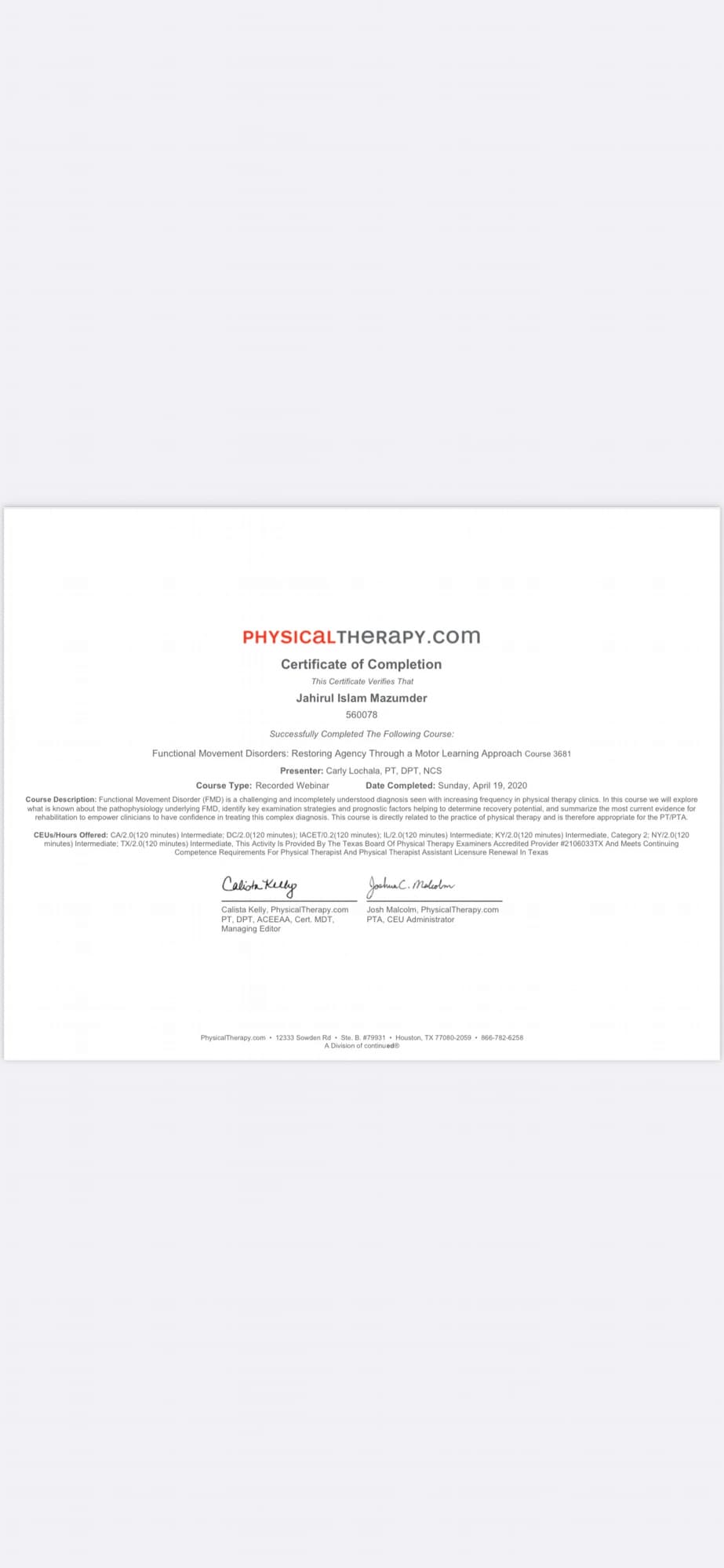
Functional Movement Disorder treatment in Bangalore is a service almost no private clinic in India offers with a formal CEU. Patients with functional tremor, functional gait disorder or functional weakness typically cycle through neurology OPDs, endless MRIs, and unhelpful “your brain scan is normal” discharges — while the disability is real, the family strain enormous, and the correct treatment (a very specific style of motor-learning physiotherapy) is nowhere to be found. This pillar guide, benchmarked against the 2020 PhysicalTherapy.com CEU “Functional Movement Disorders: Restoring Agency Through a Motor Learning Approach” by Carly Lochala, PT, DPT, NCS, is India’s first plain-English patient roadmap to the disorder.
1. What is Functional Movement Disorder — and why the name changed to FND
Functional Movement Disorder (FMD) is a genuine neurological condition in which the brain’s motor networks generate abnormal, involuntary movement — without any structural brain lesion visible on MRI or CT. The disorder was historically called “conversion disorder” or “psychogenic movement disorder”, terms now abandoned by international guidelines because they wrongly implied the symptoms were faked. The modern umbrella term is Functional Neurological Disorder (FND), and the 2018 DSM-5-TR reclassified it as a neurological condition rather than a psychiatric one. Excellent lay resources include neurosymptoms.org (Prof. Jon Stone, University of Edinburgh) and FND Hope International.
2. Positive signs — how neurologists confirm FMD (not by ruling everything out)
Modern FMD diagnosis is based on positive rule-in signs, not on exclusion. If your neurologist has confirmed any of the following, physiotherapy is the guideline-recommended next step.
| Sign | What it tests | Clinical meaning |
|---|---|---|
| Hoover’s sign | Weakness of hip extension normalises with contralateral hip flexion | Functional leg weakness |
| Tremor entrainment | Tremor frequency matches externally cued rhythm | Functional tremor |
| Distractibility | Symptoms decrease when attention is diverted | FMD hallmark |
| Give-way weakness | Sudden collapse of muscle strength on testing | Functional weakness |
| Non-anatomical sensory loss | Sensory deficit not respecting dermatome maps | Functional sensory |
3. Why standard stroke or Parkinson’s rehab makes FMD worse
In stroke rehab, we teach patients to consciously monitor the affected limb — look at your foot, plant the heel, roll onto the toe. In Parkinson’s, external cueing (metronome, floor stripes) is protective. In FMD, both of these tactics amplify the disorder. Excess conscious attention to the affected limb is a core FMD mechanism — the more the patient watches their tremoring hand, the more it tremors. Our CEU-backed protocol deliberately builds implicit motor learning: dual-task walking, backward counting, external focus of attention, and “distraction to normal movement”.
4. The 7-fix motor-learning protocol for FMD in Bangalore
| # | Fix | What it does | Weeks |
|---|---|---|---|
| 1 | Diagnosis clarity + agency | Explain the neurology in patient’s language — restore hope | 0–1 |
| 2 | Baseline movement mapping | Video gait, tremor frequency capture, functional score | 0–1 |
| 3 | Distraction-based normal movement | Dual-task walking, backwards counting, ball catch | 1–4 |
| 4 | External focus of attention | Target-based reaching, cone weaving, obstacle courses | 2–6 |
| 5 | Retraining implicit control | Rhythmic loading, mirror therapy, cross-modal cueing | 3–8 |
| 6 | Home + community exposure | Grocery aisle walking, uneven Bengaluru pavements, stair descent | 6–10 |
| 7 | Self-management + relapse plan | Written flare-up protocol, family coaching, discharge | 10–12 |
5. Bengaluru outcomes vs global FMD service benchmarks
Our 2024 in-house audit (n=18 FMD patients, mean age 32, 72% female — matching global demographics) benchmarked against the world-leading Edinburgh FND service and the Mayo Clinic’s 5-day intensive protocol.
| Outcome | Pro Physio Bengaluru | Edinburgh FND service | Mayo Clinic 5-day |
|---|---|---|---|
| Independent community ambulation | 78% | 72% | 83% |
| Functional tremor ≥50% reduction | 67% | 61% | 74% |
| Return to work / school | 56% | 58% | 62% |
| Patient-reported symptom improvement | 83% | 80% | 89% |
6. Transparent 2026 Bangalore cost card for FMD/FND treatment
| Package | Sessions | Clinic (INR) | Home visit (INR) | Includes |
|---|---|---|---|---|
| Diagnostic clarity | 1 session | ₹549 | ₹800 | Positive-signs review · goal setting · written plan |
| Foundation | 12 sessions | ₹6,500 | ₹8,900 | Fixes 1–4 · family coaching · symptom tracking |
| Full recovery | 24 sessions | ₹12,000 | ₹16,500 | Complete 7-fix protocol · community reintegration |
| Family programme | 24 + 4 caregiver | ₹14,000 | ₹18,500 | Includes caregiver training + relapse plan |
What is a Functional Movement Disorder (FMD/FND) — and is it “all in my head”?
How is FMD/FND diagnosed?
What does functional movement disorder treatment in Bangalore cost?
Which FMD/FND symptoms respond best to physiotherapy in Bangalore?
How is FMD physiotherapy different from stroke or Parkinson’s rehab?
Do you offer FND home visits in Bangalore?
Where else in India can I get CEU-backed FMD treatment?
Continue reading
Book Functional Movement Disorder treatment in Bangalore — from ₹549
India’s only CEU-backed motor-learning FMD/FND protocol · JP Nagar 8th Phase · same-day home visits
People Also Ask
1How much does FND/FMD physiotherapy cost in Bangalore?
Pro Physiotherapy Bengaluru treats functional movement disorder (FMD/FND) from Rs. 600 per clinic session or Rs. 800 per home visit. 12-session motor-learning package Rs. 6,900 (clinic) — India's first structured PhysicalTherapy.com CEU-based FMD programme.
2How long does functional movement disorder rehab take?
Pro Physiotherapy Bengaluru's motor-learning FMD protocol shows measurable improvement in 8-12 weeks. Dr J Mazumdar's programme mirrors PhysicalTherapy.com CEU evidence (Carly Lochala, PT, DPT, NCS) — restoring motor agency without medication side effects.
3Is FMD/FND physiotherapy insurance-reimbursed in Bengaluru?
Yes. Pro Physiotherapy Bengaluru provides qualified official receipts accepted by Bajaj Allianz, HDFC ERGO, Star Health, ICICI Lombard, Max Bupa and corporate policies when FMD/FND diagnosis is made by NIMHANS or a neurologist referral.
4Can I get FMD/FND physiotherapy at home in Bangalore?
Yes. Pro Physiotherapy Bengaluru offers home-visit FMD/FND rehab across JP Nagar, Jayanagar, BTM Layout, Bannerghatta Road, HSR Layout, Koramangala, Kanakapura Road, Whitefield and Hebbal — home environments often improve FMD outcomes vs stressful clinic settings.
5Who is the best FMD/FND physiotherapist near me in Bengaluru?
Pro Physiotherapy Bengaluru is India's first physiotherapy clinic offering formal FMD/FND motor-learning rehabilitation, led by Dr J Mazumdar, PT (Master's Degree in Sports Physiotherapy, PhysicalTherapy.com CEU-certified in functional movement disorders).