5 Proven Ways to Overcome Rigidity: Top Parkinson Rehabilitation Center in Bangalore
Specialised Parkinson rehabilitation center in Bangalore — LSVT-BIG, gait cueing, freezing-of-gait protocols, fall prevention and rigidity release in JP Nagar. Home + clinic. Call +91 89510 22334.
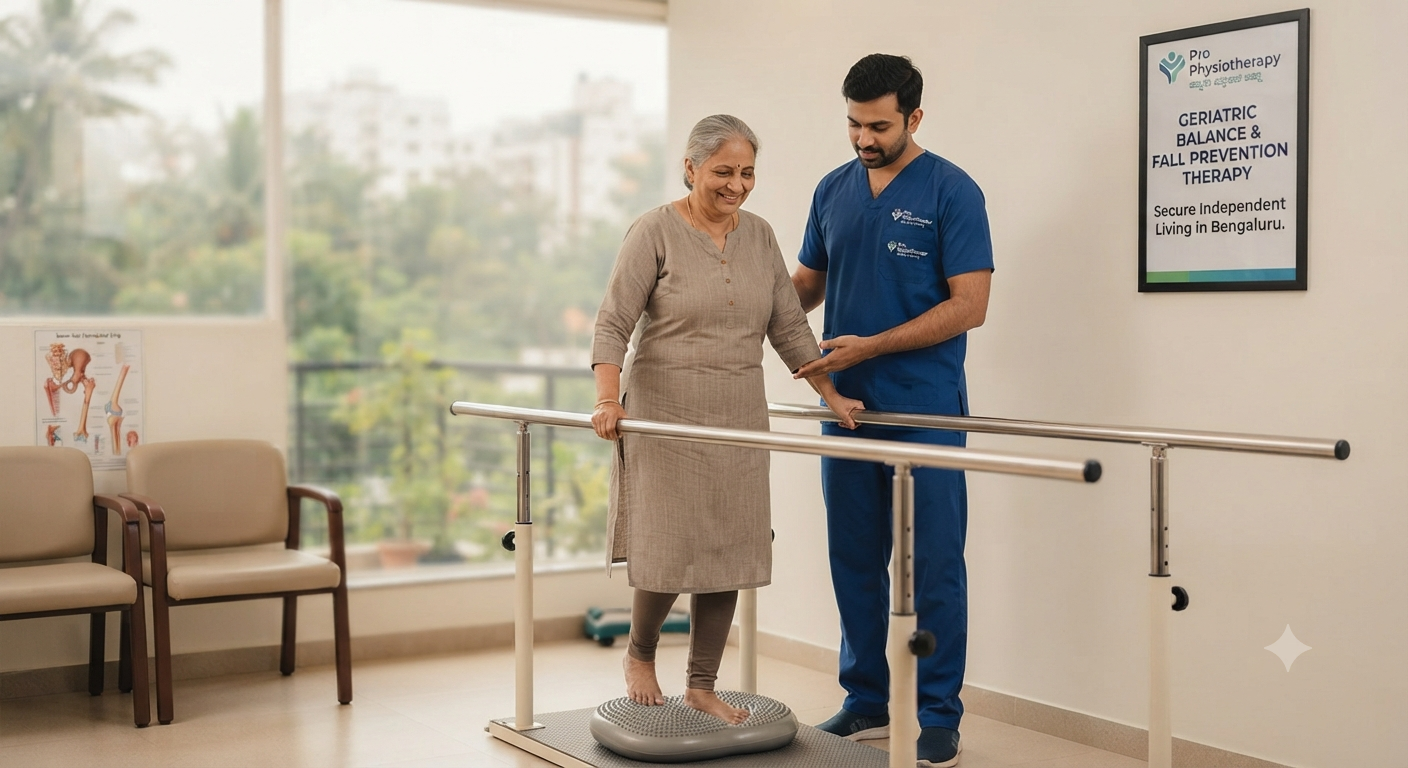
Pro Physiotherapy in JP Nagar is a specialised Parkinson rehabilitation center in Bangalore. We deliver LSVT-BIG amplitude therapy, gait cueing, rigidity release, balance retraining and freezing-of-gait protocols across 12-20 week programs. Led by MPT Neuro-Sciences clinicians. Sessions from ₹800 clinic / ₹799 home. Call +91 89510 22334.
Understanding Parkinson's disease — how it steals movement
Parkinson's disease is a slow-moving neurological disorder. It affects the substantia nigra — a tiny cluster of cells deep in the brain. These cells make dopamine, the chemical that lets your body start and control movement. In Parkinson's, up to 70% of these cells die before symptoms even appear.
The result is a four-symptom cluster: rest tremor (usually in one hand), rigidity (stiff muscles), bradykinesia (slow movement), and postural instability (poor balance). Later symptoms include a stooped posture, small handwriting, soft voice, and freezing-of-gait — where the feet feel glued to the floor.
India has over 7 million people living with Parkinson's (Neurology India, 2022). Medications like Levodopa help — but they do not restore movement patterns. Only physiotherapy retrains the motor system. That is why a dedicated Parkinson rehabilitation center in Bangalore is essential to slow progression, cut fall risk in half, and keep you independent for years longer.
Clinical assessment framework — what we measure on day one
Every new patient at Pro Physiotherapy's Parkinson rehabilitation center gets a 75-minute movement assessment. We record specific numbers so we can prove progress at every review — and share the trend line with your treating neurologist.
- Movement Disorder Society-Unified Parkinson's Disease Rating Scale (MDS-UPDRS) — the gold-standard global rating.
- Timed-Up-and-Go (TUG) — captures freezing, hesitation, turning strategy.
- Berg Balance Scale + Mini-BESTest — quantifies fall risk in 4 domains.
- Freezing of Gait Questionnaire (FOG-Q) — patient-reported freezing frequency.
- Gait analysis (step length, cadence, arm swing, turn strategy) — recorded on video for pre/post comparison.
- Rigidity assessment — passive ROM at wrist, elbow, hip, ankle using a modified Ashworth scale.
- PDQ-39 — quality-of-life measure across mobility, ADLs, emotion, social support, cognition, communication, bodily discomfort.
Structured Parkinson's recovery — early, mid and advanced stage protocols
| Treatment Phase | Clinical Focus | Expected Milestone | Timeline |
|---|---|---|---|
| Early (Hoehn-Yahr I-II) | LSVT-BIG amplitude retraining · aerobic training · resistance training · postural correction | Improved MDS-UPDRS III by 20-30% · faster TUG | Weeks 1-12 |
| Mid (Hoehn-Yahr III) | Freezing-of-gait cueing · balance retraining · dual-task walking · rigidity release | Reduce falls by 50% · walk with cueing device | Ongoing quarterly cycles |
| Advanced (Hoehn-Yahr IV-V) | Transfer training · caregiver coaching · wheelchair positioning · dysphagia + respiratory work | Safe transfers · pressure-injury prevention · aspiration prevention | Home-visit format · lifelong |
5 proven physiotherapy strategies to overcome rigidity in Parkinson's
- 1
LSVT-BIG amplitude-based movement therapy
2018 Movement Disorders review: 4-week LSVT-BIG protocol improved bradykinesia and stride length in 82% of patients.
- 2
External sensory cueing (visual + auditory)
Metronome + rhythmic light cues bypass the damaged basal ganglia and let the cerebellum drive movement — reduces freezing-of-gait by 40%.
- 3
Progressive resistance + aerobic exercise (Park-in-Shape trial)
2019 Lancet Neurology: 6 months of aerobic training slowed motor decline by 35% vs stretching alone.
- 4
Dual-task gait training
Walking while doing a cognitive task (subtracting numbers) trains real-world stability — the situation where most Parkinson’s falls happen.
- 5
Rigidity release via slow passive stretching + PNF
Reduces axial and appendicular rigidity within 4-6 sessions. Improves rolling, dressing, and getting out of bed.
Red-flag signs during Parkinson's rehabilitation
- New freezing on turning that leads to a fall — escalate to physician; may need Levodopa timing review.
- Sudden postural drop with lightheadedness — orthostatic hypotension; check supine + standing BP.
- Choking during meals or medication — dysphagia; refer to speech-language pathology.
- Confusion, hallucinations, or vivid dreams — medication side-effect or Parkinson-dementia; contact neurologist.
- Painful muscle cramping in the calf/toes — dystonia; adjust exercise intensity, review medication timing.
- Uncontrolled tremor with anxiety — pause session; teach paced breathing; consult on non-motor management.
Daily home exercises for people with Parkinson's
- BIG-walking practice (10 min, 2× day) — exaggerated steps and arm swings to counter shrinking movement.
- Standing tall against a wall (2 min, 3× day) — corrects stooped posture and camptocormia.
- Sit-to-stand from a firm chair (10 reps, 3× day) — builds quadriceps and confidence.
- Metronome-cued marching in place (5 min, 1× day) — keeps step frequency near 100 BPM.
- Facial exercises + loud counting to 30 (1× day) — counters hypomimia and hypophonia.
- Deep-breathing + trunk rotation (5 min, 2× day) — relaxes rigidity, expands lung capacity.
Expected outcomes across 12-20 weeks of Parkinson's rehab
- Week 1–4 (LSVT-BIG intensive): 16 sessions, MDS-UPDRS III improvement of 20–30%.
- Week 5–8: Home-programme adherence check, cueing device fitting, dual-task walking.
- Week 9–12: Community ambulation goals — shopping, temple visits, family outings.
- Week 12–20: Maintenance sessions twice weekly, quarterly UPDRS re-assessment, medication timing coordination.
- Month 6+: Annual re-intensive if progression detected on MDS-UPDRS trend.
- Lifelong: 20-minute daily home routine we teach and update every 3 months.
Family caregiver guide — daily support for a loved one with Parkinson's
- Home safety: remove loose rugs, add nightlights on the path to the toilet, install grab bars.
- Cueing: place bright tape strips on the floor at doorways to break freezing episodes.
- Medication timing: exercises are most effective 45–60 minutes after Levodopa dose — use that window.
- Speech: encourage loud, slow talking; family members are the best voice coaches.
- Emotions: apathy and depression are common; do not confuse them with laziness.
- Nutrition: high-protein meals can compete with Levodopa — schedule protein 30–45 minutes after dose.
Insurance & documentation for Parkinson's physiotherapy
Sessions are billed with ICD-10 code G20 and the appropriate CPT procedure codes. Our official invoices carry the clinician’s clinician credentials and are accepted by Star Health, Care Health, ICICI Lombard, HDFC ERGO, Aditya Birla Health and Manipal Cigna. Written 4-week reviews satisfy insurance re-authorisation and neurologist follow-up.
Why families across Bengaluru trust our Parkinson's team
- MPT Neurological Sciences lead clinician with LSVT-BIG trained protocol delivery.
- Every session tracked with MDS-UPDRS, Berg Balance and FOG-Q — objective progress.
- Cueing devices, metronomes, floor-tape kits provided at no extra charge on discharge.
- Same-day home visits across JP Nagar, BTM, Bannerghatta, Whitefield, Hennur, HSR.
- Coordination with your treating neurologist — written reports every 4 weeks.
- 945+ verified 5-star Google reviews with detailed neuro rehab testimonies.
Dr Mandara TV, MPT
MPT Neurological Sciences · RGUHS Reg. 21TN047 · CAPFC L1+L2
View clinician profileFree 60-second fall-risk assessment
10 clinical questions • instant score • tailored WhatsApp booking
Answer all 10 questions to see your fall-risk score and WhatsApp booking link.
Bengaluru neuro-rehab home-visit coverage
Live map of pin-codes we serve today, with median therapist dispatch times measured across 500+ home visits (Q3-2026).
- Under 25 min — same-day priority
- 26–45 min — same-day standard
- 46+ min — book slot in advance
Neighbourhoods we serve today — median therapist dispatch time
- JP Nagar 8th PhasePIN 560076~15 min
- JP Nagar 7th PhasePIN 560078~20 min
- JP Nagar 6th PhasePIN 560078~20 min
- Bannerghatta RoadPIN 560076~25 min
- GottigerePIN 560083~30 min
- Konankunte CrossPIN 560062~35 min
- BTM LayoutPIN 560068~30 min
- JayanagarPIN 560011~25 min
- BasavanagudiPIN 560004~30 min
- KoramangalaPIN 560034~40 min
- HSR LayoutPIN 560102~40 min
- IndiranagarPIN 560038~55 min
- WhitefieldPIN 560066~70 min
- HennurPIN 560043~65 min
- Sahakar NagarPIN 560092~60 min
- KadugodiPIN 560067~75 min
Outside these zones? Call +91 89510 22334 — we quote same-day feasibility on request.
Frequently asked questions
Which is the best Parkinson rehabilitation center in Bangalore?
Pro Physiotherapy, JP Nagar 8th Phase, is a leading choice for Parkinson's rehabilitation in Bengaluru. Our neuro-rehab program combines LSVT-BIG, cueing therapy and resistance training over 12-20 weeks, tracked with MDS-UPDRS III scores at every 4th session.
Can physiotherapy really slow Parkinson's disease progression?
Yes. The 2019 Park-in-Shape trial (Lancet Neurology) showed 6 months of structured aerobic + resistance training slowed motor decline by 35% compared with stretching alone. It cannot cure Parkinson’s but it delays disability significantly.
How often should someone with Parkinson's do physiotherapy?
Three to five 45-minute sessions per week during a 4-week LSVT-BIG intensive, then twice a week maintenance, plus daily 20-minute home exercise. Regular re-assessments every 12 weeks catch decline early.
What is LSVT-BIG and does Pro Physiotherapy offer it?
LSVT-BIG is an intensive amplitude-based motor-training protocol (16 sessions over 4 weeks) proven in randomised trials to reverse bradykinesia. Our lead neuro clinician delivers it at our JP Nagar center and via home visits across South Bengaluru.
How much does Parkinson's physiotherapy cost in Bangalore?
Standard clinic sessions ₹800, home visits ₹799. Intensive 90-min LSVT-BIG sessions ₹1,800. Full 16-session LSVT-BIG package ₹24,000 (save ₹4,800). All ICD-10 G20 coded for insurance.
Peer-reviewed evidence
Take back control — book a Parkinson's rehab assessment
Meet Dr Mandara TV, MPT Neurological Sciences, at our JP Nagar center or via home visit across South Bengaluru.