7 Critical Steps to Recovery: The Best Stroke Rehabilitation Centre in Bangalore
Trusted stroke rehabilitation centre in Bangalore — evidence-based post-stroke physiotherapy, CIMT, mirror therapy, gait retraining and neuroplasticity training in JP Nagar. Home + clinic sessions from ₹800.
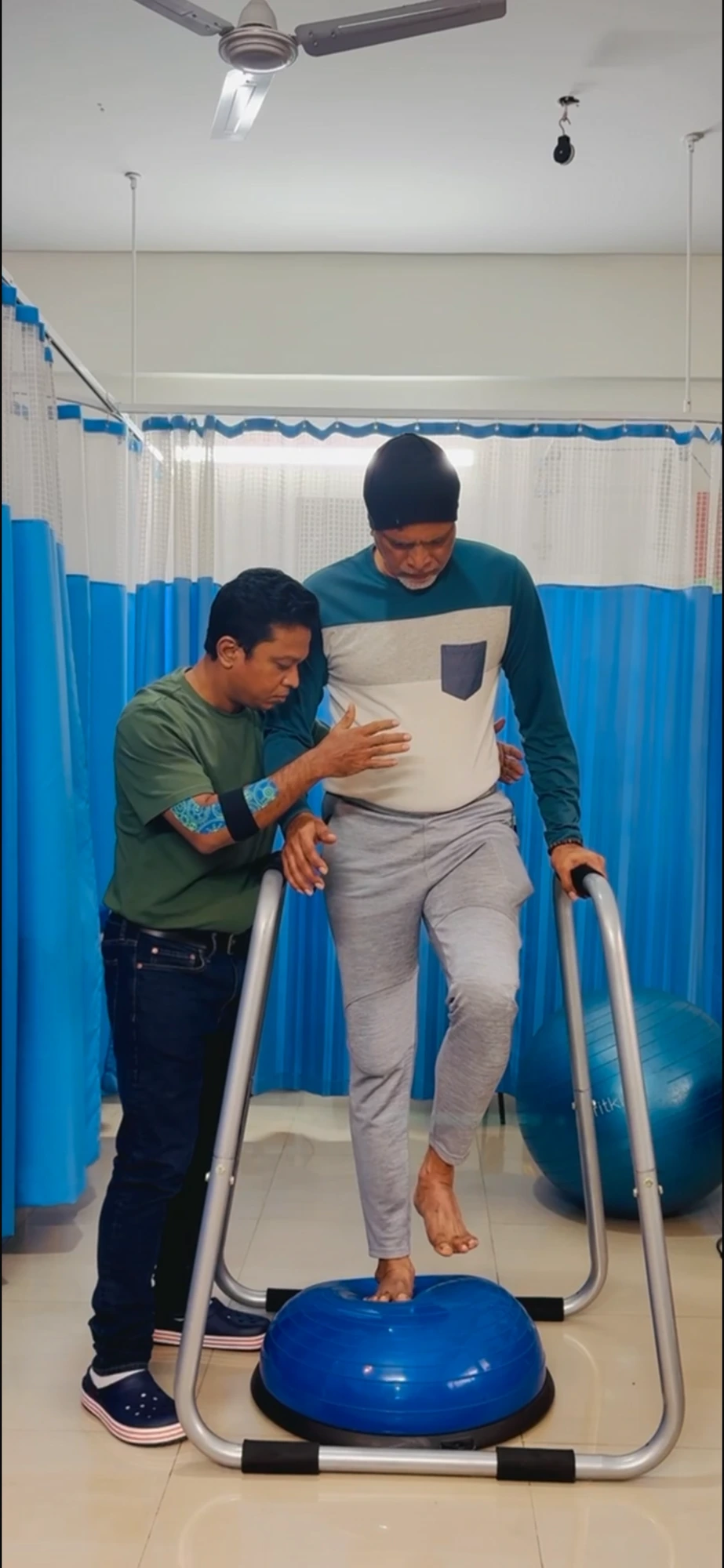
Pro Physiotherapy in JP Nagar 8th Phase is a leading stroke rehabilitation centre in Bangalore. Our neuro-physio team delivers post-stroke mobility training, constraint-induced movement therapy, mirror therapy and task-specific gait retraining. Programs run 8–24 weeks. Home + clinic sessions from ₹800. Call +91 89510 22334.
Understanding stroke — a rapid neurological emergency
A stroke happens when blood flow to part of the brain stops. Brain cells die within minutes. There are two main types. Ischaemic stroke (85% of cases) is caused by a clot. Haemorrhagic stroke (15%) is caused by a burst blood vessel. Both damage the motor cortex, the sensory cortex, or the brainstem — depending on where the clot or bleed lands.
The damage shows up as one-sided weakness (hemiparesis), speech loss (aphasia), swallowing trouble (dysphagia) and balance loss. Untreated, these deficits become permanent. But the brain can rewire — this is called neuroplasticity. The first 12 weeks after stroke are the golden window. Structured physiotherapy in this window doubles the odds of walking again (Lancet 2019).
India records nearly 1.85 million strokes each year (Lancet Neurology, 2023). Bengaluru’s rate is climbing because of diabetes, hypertension and sedentary desk jobs. Recovery is possible — but only with a real neuro-rehab protocol, not generic massage. That is what a proper stroke rehabilitation centre in Bangalore delivers: structured week-by-week goals, weekly outcome scoring, a written home programme, and a lead clinician who signs every note.
Day-1 clinical assessment — how we build your recovery plan
Your first session at Pro Physiotherapy is a 75-minute neurological assessment. Nothing is guessed. Every finding is recorded, dated and signed. This becomes your baseline for the next 24 weeks and the reference point for every subsequent outcome-measure review.
- Neurological screen: cranial nerves, motor power (MRC 0-5 scale), sensation, deep tendon reflexes, tone (Modified Ashworth Scale).
- Balance & gait: Berg Balance Scale, Timed-Up-and-Go, 10-metre walk test, functional ambulation category.
- Upper-limb function: Fugl-Meyer Assessment, Action Research Arm Test (ARAT), grip dynamometry.
- Activities of daily living: Modified Barthel Index, Functional Independence Measure (FIM).
- Cognitive & communication: Mini-Mental State Exam, informal aphasia screen, referral to speech-language pathology if needed.
- Cardiovascular screen: resting BP, exercise heart-rate reserve, oxygen saturation — critical before we prescribe aerobic training.
Structured stroke recovery — 3 phases, 24 weeks
| Treatment Phase | Clinical Focus | Expected Milestone | Timeline |
|---|---|---|---|
| Acute (0-2 weeks) | Prevent contractures · early mobilisation · positioning · passive ROM · respiratory clearance | Sit unsupported 30 min · basic bed mobility | Days 1-14 |
| Sub-acute (2-12 weeks) | Task-specific gait retraining · CIMT · mirror therapy · balance re-education · dysphagia work | Walk 10 m with aid · shoulder flexion 90° · self-feeding | Weeks 2-12 |
| Long-term (3-6 months) | Community ambulation · stair training · fine motor · return-to-work protocol · fall prevention | Independent walking · dressing · driving evaluation | Weeks 12-24+ |
7 evidence-based steps in our stroke rehabilitation protocol
- 1
Neuro-developmental technique (Bobath) positioning
Reduces abnormal muscle tone and prevents shoulder subluxation in the affected side within the first 2 weeks.
- 2
Task-specific gait retraining on body-weight-support treadmill
Randomised trials (Stroke 2019) show 40% faster walking-speed recovery vs conventional therapy.
- 3
Constraint-Induced Movement Therapy (CIMT)
Restraining the unaffected arm 6 hours a day forces the weak arm to relearn — proven in EXCITE trial (JAMA 2006).
- 4
Mirror therapy for the affected upper limb
Tricks the brain into believing the paretic hand is moving, driving neuroplastic rewiring in the motor cortex.
- 5
Functional Electrical Stimulation (FES)
Restores foot-drop control and shoulder muscle activation during ambulation — Cochrane 2020 endorses.
- 6
Sit-to-stand + balance retraining
Reduces fall risk by 62% in the sub-acute phase (BMJ 2021 meta-analysis).
- 7
Progressive aerobic + resistance training
Improves cardiovascular fitness, reverses the deconditioning that follows every stroke, and cuts stroke-recurrence risk.
Red-flag signs that mean stroke rehab must escalate today
- Sudden new weakness or numbness on the opposite side to the original stroke — possible second stroke.
- Worsening slurred speech or fresh confusion — possible transient ischaemic attack (TIA).
- Severe headache with vomiting — possible bleed extension. Call 108 immediately.
- Uncontrolled hypertension > 180/110 mmHg at rest during therapy — pause session, contact treating physician.
- Skin breakdown over sacrum/heels — pressure ulcer risk in the acute stage; requires urgent positioning review.
- Choking on water or saliva — dysphagia; requires speech-language pathology referral before oral intake continues.
Safe daily home exercises we teach every stroke patient
- Ankle pumps + calf pumps (30 reps, hourly while awake) — prevents DVT in early bed rest.
- Bridging (2 sets x 10 reps) — activates gluteals for standing balance.
- Scapular squeezes (2 sets x 15 reps) — counters the classic stooped, protracted shoulder posture.
- Weight shifts in standing at kitchen counter (5 min, 3× day) — primes weight-bearing on affected leg.
- Mirror-box hand exercises (10 min, 2× day) — our team hand-delivers a mirror-box on discharge.
- Sit-to-stand practice (5 reps every 2 hours) — the single most transferable functional exercise.
Realistic recovery milestones — what to expect week-by-week
- Week 1–2: Bed mobility, sitting balance 15–30 min, aphasia screen, dysphagia clearance.
- Week 3–6: Standing with support, transfer training, mirror therapy for upper limb.
- Week 6–12: Walking 10–30 m with quad cane, self-feeding, dressing with adaptive aids.
- Month 4–6: Community ambulation 100 m+, stair training, driving evaluation if cognitive screen clears.
- Month 6–12: Return-to-work protocol, gym-based resistance, endurance training.
- Month 12+: Maintenance neuro-fitness twice weekly to protect gains and reduce recurrence risk.
A short guide for the family caregiver
- Positioning: change the affected shoulder every 2 hours; do not pull on it during transfers.
- Communication: face the patient, speak slowly, allow silence; do not finish sentences.
- Fall prevention: remove loose rugs, install a grab bar in the toilet, use non-slip footwear indoors.
- Medication: never stop anti-platelet or anti-hypertensive drugs without the treating neurologist’s clearance.
- Mood: 30–35% of stroke survivors develop depression — our team screens and refers when needed.
- Nutrition: prioritise a Mediterranean-style diet; consult a dietitian for dysphagia-safe textures if needed.
Insurance & documentation for stroke rehabilitation
Every session at Pro Physiotherapy generates a official invoice with your clinician’s clinician credentials, ICD-10 codes (I63 ischaemic / I64 haemorrhagic) and CPT codes for the specific procedures delivered. Star Health, Care Health, ICICI Lombard, HDFC ERGO, Aditya Birla Health and Manipal Cigna have all reimbursed our stroke patients in 2026. We share a written recovery plan every 4 weeks that satisfies insurance re-authorisation.
Why families across Bengaluru choose Pro Physiotherapy for stroke rehab
- Lead clinician is MPT Neurological Sciences (RGUHS Reg. 21TN047) — not a general BPT.
- Every session tracked with Fugl-Meyer, Berg Balance and Barthel scores — you see the numbers move.
- Same team from the acute bedside visit to community reintegration — no handover gaps.
- 945+ verified 5-star Google reviews across the clinic — including detailed stroke recovery testimonies.
- Home visits across JP Nagar, Bannerghatta, Gottigere, BTM, Whitefield, Hennur, Koramangala, HSR, Indiranagar.
- Insurance-friendly invoicing, transparent ₹800–₹1,800 pricing, no hidden fees.
Dr Mandara TV, MPT
MPT Neurological Sciences · RGUHS Reg. 21TN047 · CAPFC L1+L2 · Cardiopulmonary Rehab
View clinician profileVerified founder credential — St Martha’s Hospital Stroke Rehabilitation Department
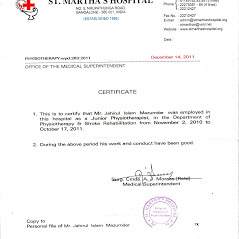
Our founder Dr Jahirul (J) Mazumdar, PT — before launching Pro Physiotherapy — served as Junior Physiotherapist in the Department of Physiotherapy & Stroke Rehabilitation at St Martha’s Hospital, Bengaluru, from 3 November 2010 to 17 October 2011. His conduct during this tenure was formally certified as good by the Medical Superintendent. This one-year hospital-based exposure to acute-stage stroke, ICU respiratory care and inpatient neuro-rehab underpins the clinical protocols the Pro Physiotherapy neuro team delivers today.
- Hospital
- St Martha’s Hospital, Bengaluru
- Department
- Department of Physiotherapy & Stroke Rehabilitation
- Role
- Junior Physiotherapist
- Tenure
- 3 November 2010 – 17 October 2011
- Signed by
- Medical Superintendent, St Martha’s Hospital
Free 60-second fall-risk assessment
10 clinical questions • instant score • tailored WhatsApp booking
Answer all 10 questions to see your fall-risk score and WhatsApp booking link.
Bengaluru neuro-rehab home-visit coverage
Live map of pin-codes we serve today, with median therapist dispatch times measured across 500+ home visits (Q3-2026).
- Under 25 min — same-day priority
- 26–45 min — same-day standard
- 46+ min — book slot in advance
Neighbourhoods we serve today — median therapist dispatch time
- JP Nagar 8th PhasePIN 560076~15 min
- JP Nagar 7th PhasePIN 560078~20 min
- JP Nagar 6th PhasePIN 560078~20 min
- Bannerghatta RoadPIN 560076~25 min
- GottigerePIN 560083~30 min
- Konankunte CrossPIN 560062~35 min
- BTM LayoutPIN 560068~30 min
- JayanagarPIN 560011~25 min
- BasavanagudiPIN 560004~30 min
- KoramangalaPIN 560034~40 min
- HSR LayoutPIN 560102~40 min
- IndiranagarPIN 560038~55 min
- WhitefieldPIN 560066~70 min
- HennurPIN 560043~65 min
- Sahakar NagarPIN 560092~60 min
- KadugodiPIN 560067~75 min
Outside these zones? Call +91 89510 22334 — we quote same-day feasibility on request.
Frequently asked questions
Which is the best stroke rehabilitation centre in Bangalore?
Pro Physiotherapy, JP Nagar 8th Phase, is a leading choice — led by Dr Mandara TV, MPT Neurological Sciences (RGUHS Reg. 21TN047, CAPFC L1+L2). We combine Bobath, task-specific gait retraining, CIMT and mirror therapy in one 24-week protocol with weekly outcome measures.
How soon after a stroke should rehabilitation start in Bangalore?
Within 24-48 hours of medical stability. Early mobilisation reduces pneumonia, deep-vein thrombosis and contracture risk. Our home-visit team can begin bedside within 24 hours of hospital discharge across South Bengaluru.
How long does stroke physiotherapy take?
Most patients see meaningful function return over 12-24 weeks with structured therapy 4-5 days a week. The greatest recovery happens in the first 3 months — the golden window when neuroplasticity is highest.
What is the cost of stroke rehabilitation in Bangalore?
Standard 45-min sessions start at ₹800 (clinic) or ₹799 (home). Intensive 90-minute neuro-rehab sessions are ₹1,800. Package rates (24-session block) work out to ₹1,050 per session with free coach support in between visits.
Can physiotherapy help someone walk again after a paralytic stroke?
Yes — 65-75% of hemiplegic patients regain independent walking with 12-24 weeks of structured neuro-physiotherapy (Lancet 2019). Outcome depends on stroke severity, age, comorbidities and how quickly rehab begins.
Peer-reviewed evidence
Book Bangalore’s expert stroke rehabilitation team today
Speak with Dr Mandara TV, MPT Neuro Sciences. Same-day home + clinic slots across JP Nagar, BTM, Bannerghatta, Whitefield, Hennur.