9 Advanced Protocols at Leading Paralysis Rehabilitation Centres in Bangalore
Specialised paralysis rehabilitation centres in Bangalore — spinal cord injury physiotherapy, FES, body-weight-supported treadmill training and motor function recovery in JP Nagar. Home + clinic sessions.
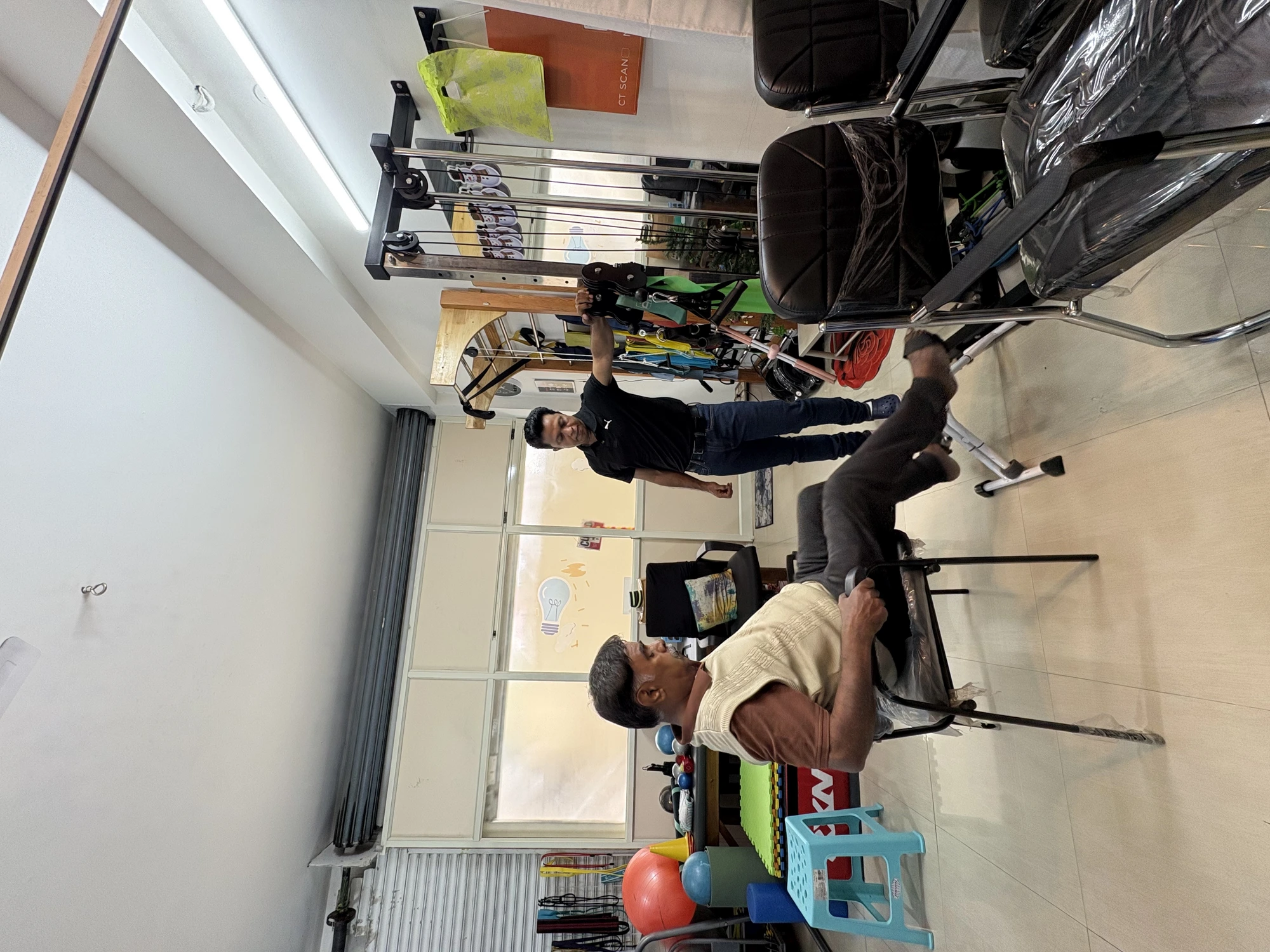
Pro Physiotherapy is one of the leading paralysis rehabilitation centres in Bangalore. We deliver spinal-cord-injury physiotherapy, functional electrical stimulation, body-weight-supported treadmill training, and neuro-motor relearning programs over 6-18 months. Led by an MPT Neuro clinician. Home + clinic sessions from ₹800. Call +91 89510 22334.
Understanding paralysis — the different types and causes
Paralysis is the total or partial loss of voluntary muscle movement. It happens when the signal between the brain and the muscles is broken. The break can be in the brain (stroke, traumatic brain injury), in the spinal cord (accident, tumour, transverse myelitis), or in the peripheral nerves (Guillain-Barré, polio).
The classification depends on how many limbs are affected. Monoplegia is one limb. Hemiplegia is one side of the body — often after a stroke. Paraplegia is both legs — usually from a thoracic or lumbar spinal-cord injury. Quadriplegia (tetraplegia) is all four limbs — usually from a cervical spinal-cord injury.
India records about 15,000 new spinal-cord-injury cases each year (Indian Journal of Orthopaedics, 2023). Road traffic accidents cause the majority. Recovery is possible even with complete injuries — the concept of neuroplasticity below the level of the lesion is well documented. Structured rehabilitation at a dedicated paralysis rehabilitation centre in Bangalore is the single strongest predictor of independence.
Day-1 clinical assessment — the numbers we track
Every new patient at Pro Physiotherapy’s paralysis rehabilitation centre undergoes a 90-minute assessment. It combines neurological, functional, respiratory and psychosocial screens.
- American Spinal Injury Association (ASIA) Impairment Scale — gold-standard SCI severity grading (A-E).
- Manual Muscle Testing (MRC 0-5) across every major muscle group.
- Sensory examination — light touch and pinprick across 28 dermatomes.
- Spinal Cord Independence Measure (SCIM-III) — tracks self-care, respiration, mobility.
- Modified Ashworth Scale — spasticity grading at ankle, knee, hip, wrist, elbow.
- Respiratory screen — vital capacity, peak cough flow (critical in cervical SCI).
- Bladder + bowel function — coordination with urology for the neurogenic pattern.
- Psychosocial screen — mood, family support, financial constraints. Recovery is not just physical.
Structured paralysis recovery — acute, sub-acute, chronic phases
| Treatment Phase | Clinical Focus | Expected Milestone | Timeline |
|---|---|---|---|
| Acute (0-6 weeks) | Respiratory clearance · pressure-injury prevention · passive ROM · positioning · early mobilisation | Independent sitting balance · clear chest · intact skin | Weeks 0-6 |
| Sub-acute (6 weeks-6 months) | FES · body-weight-supported treadmill · task-specific hand training · orthotic prescription · transfer training | Independent transfers · assisted stepping · ADL basics | Weeks 6-24 |
| Chronic (6-18 months) | Community reintegration · wheelchair skills · driving evaluation · vocational retraining · gym-based strength | Independent community mobility · return to work · advanced ADLs | Weeks 24-72+ |
9 advanced protocols delivered at Pro Physiotherapy’s paralysis rehabilitation centre
- 1
Functional Electrical Stimulation (FES)
Restores volitional muscle activity below the level of the lesion — proven to enable stepping in incomplete SCI (JNER 2022).
- 2
Body-weight-supported treadmill training (BWSTT)
Task-specific gait retraining that drives locomotor CPG activity in the spinal cord itself.
- 3
Robotic-assisted gait training (partnered with tertiary centres)
For select ASIA C/D patients — exoskeleton walking accelerates community-ambulation goals.
- 4
Constraint-Induced Movement Therapy (CIMT) for hemiplegia
Forces the affected limb to relearn — EXCITE trial evidence.
- 5
Respiratory + cough-assist training (cervical SCI)
Prevents the pneumonia that kills more chronic-SCI patients than the injury itself.
- 6
Wheelchair skills + transfer training (Cariello protocol)
Independent transfers are the single biggest predictor of returning home safely.
- 7
Task-specific hand + upper-limb rehab (Graded Repetitive Arm Supplementary Programme, GRASP)
Evidence-based UL protocol for hemiplegia; adaptable to incomplete SCI.
- 8
Cardiovascular reconditioning (arm ergometry / FES cycling)
Paralysis rapidly deconditions the heart. Structured CV training reduces secondary complications 40%.
- 9
Psychosocial + family caregiver coaching
Depression rate after paralysis reaches 40%. Our program includes counselling referral + weekly family sessions.
Red-flag signs that need urgent escalation in paralysis care
- Fever + productive cough — pneumonia is the leading cause of death in chronic SCI. Escalate today.
- Skin redness that does not blanch over sacrum, heels, ischial tuberosities — stage-1 pressure injury.
- Autonomic dysreflexia signs (pounding headache, sudden BP spike) in T6 or above SCI — medical emergency.
- New spasticity spike beyond baseline — rule out UTI, kidney stone, ingrown toenail, fracture.
- Sudden increase in trunk sweating below the level of injury — possible autonomic dysreflexia trigger.
- Loss of previous motor function — rule out post-traumatic syringomyelia (needs urgent MRI).
Safe home exercises we teach every paralysis patient
- Pressure-relief lifts every 15 minutes in the wheelchair — the single most important skin-saver.
- Passive ROM to all paralysed joints (10 reps each, 2× day) — prevents contracture.
- Deep breathing + assisted cough (10 reps every 2 hours) — vital in cervical SCI.
- Arm ergometry (10 min, 2× day) — protects cardiovascular fitness.
- Standing frame use (30 min, 3× week) — preserves bone density and bladder function.
- Grip and pinch strengthening (10 min, 2× day) — for incomplete cervical injuries.
Realistic recovery journey across 6-18 months
- Week 0–6 (acute): Clear chest, intact skin, independent sitting balance.
- Week 6–12: Transfers with sliding board, wheelchair skills, upper-limb strengthening.
- Month 3–6: Assisted stepping in parallel bars (incomplete injuries), independent grooming.
- Month 6–12: Community wheelchair mobility, driving evaluation, vocational retraining.
- Month 12–18: Return to work with adaptive equipment, gym-based strength, advanced ADLs.
- Month 18+: Maintenance protocol, annual re-assessment, secondary-complication screening.
Family caregiver essentials — what to learn in the first 6 weeks
- Skin checks twice daily — mirror-check sacrum, heels, ischial tuberosities every morning and evening.
- Turning schedule — every 2 hours in bed until pressure-tolerance is established.
- Bowel + bladder programme — our team teaches timing, technique and equipment.
- Safe transfer technique — back protection for the caregiver is as important as patient safety.
- Recognising autonomic dysreflexia — pounding headache, high BP; sit patient up, check bladder, call 108.
- Emotional support — depression is common; keep the counsellor referral open, not just for the patient.
Insurance & documentation for paralysis rehabilitation
Every invoice carries ICD-10 code G82.x (paraplegia/quadriplegia), the treating clinician’s clinician credentials, and the CPT codes for procedures delivered. Star Health, Care Health, ICICI Lombard, HDFC ERGO, Aditya Birla Health and Manipal Cigna have all reimbursed our paralysis patients in 2026. Written 4-week reviews with ASIA and SCIM-III scores satisfy insurance re-authorisation.
Why Bengaluru families trust Pro Physiotherapy for paralysis rehab
- MPT Neurological Sciences lead clinician with cardiopulmonary rehab credential — critical for cervical SCI.
- Portable FES unit, tilt-table, pressure-relief cushion carried on every home visit.
- Same team continuity from bedside acute care to community reintegration.
- Family caregiver coaching baked into every long-duration package.
- Home visits across JP Nagar, Bannerghatta, Gottigere, BTM, Whitefield, Hennur, Indiranagar.
- Insurance-friendly documentation, ICD-10 coded invoices, 4-weekly outcome reports.
Dr Mandara TV, MPT
MPT Neurological Sciences · RGUHS Reg. 21TN047 · CAPFC L1+L2 · Cardiopulmonary Rehab
View clinician profileFree 60-second fall-risk assessment
10 clinical questions • instant score • tailored WhatsApp booking
Answer all 10 questions to see your fall-risk score and WhatsApp booking link.
Bengaluru neuro-rehab home-visit coverage
Live map of pin-codes we serve today, with median therapist dispatch times measured across 500+ home visits (Q3-2026).
- Under 25 min — same-day priority
- 26–45 min — same-day standard
- 46+ min — book slot in advance
Neighbourhoods we serve today — median therapist dispatch time
- JP Nagar 8th PhasePIN 560076~15 min
- JP Nagar 7th PhasePIN 560078~20 min
- JP Nagar 6th PhasePIN 560078~20 min
- Bannerghatta RoadPIN 560076~25 min
- GottigerePIN 560083~30 min
- Konankunte CrossPIN 560062~35 min
- BTM LayoutPIN 560068~30 min
- JayanagarPIN 560011~25 min
- BasavanagudiPIN 560004~30 min
- KoramangalaPIN 560034~40 min
- HSR LayoutPIN 560102~40 min
- IndiranagarPIN 560038~55 min
- WhitefieldPIN 560066~70 min
- HennurPIN 560043~65 min
- Sahakar NagarPIN 560092~60 min
- KadugodiPIN 560067~75 min
Outside these zones? Call +91 89510 22334 — we quote same-day feasibility on request.
Frequently asked questions
Which are the best paralysis rehabilitation centres in Bangalore?
Pro Physiotherapy in JP Nagar 8th Phase is among the top-rated paralysis rehabilitation centres in Bangalore — led by Dr Mandara TV, MPT Neurological Sciences (RGUHS Reg. 21TN047). Our 9-protocol program combines FES, BWSTT, CIMT and family caregiver coaching.
Can physiotherapy help someone walk again after paralysis?
Yes for many incomplete injuries (ASIA B, C, D). Complete injuries (ASIA A) rarely recover volitional walking but can regain sitting balance, transfers, driving, and functional independence with 6-18 months of structured therapy.
How long is a typical paralysis recovery program in Bangalore?
A structured neuro-rehab program lasts 6-18 months. Acute phase 4-6 weeks, sub-acute 3-6 months, chronic 6-12 months. Home-visit and clinic sessions are blended to maximise family involvement and reduce transport burden.
What is the cost of paralysis physiotherapy in Bangalore?
Standard sessions ₹800 clinic / ₹799 home. 90-min intensive neuro sessions ₹1,800. Long-duration packages (24-48 sessions) reduce to ₹1,050 per session. ICD-10 codes G82.x on the invoice for insurance reimbursement.
Can Pro Physiotherapy visit us at home for paralysis rehab?
Yes. Home visits cover JP Nagar, Bannerghatta, Gottigere, BTM, Jayanagar, Whitefield, Hennur, Koramangala, HSR, Indiranagar. Our therapist brings a portable FES unit, tilt-table, therabands and pressure-relief cushion.
Peer-reviewed evidence
Book expert paralysis rehabilitation today
Meet Dr Mandara TV, MPT Neurological Sciences, at our JP Nagar center or arrange a home visit anywhere across South Bengaluru.