Lower-Crossed Syndrome Corrective Therapy in Bangalore — Advanced Fix for Stubborn Pelvic Tilt in 8-12 Sessions (2026)
Lower-crossed syndrome (LCS) — Janda’s classic pattern of tight iliopsoas + rectus femoris + erector spinae with weak deep abdominals + glutes — produces anterior pelvic tilt, exaggerated lumbar lordosis and chronic mechanical low-back pain. Pro Physiotherapy Bangalore’s 3-phase corrective protocol (Assess → Release → Reactivate) restores neutral pelvic position in 8-12 sessions.
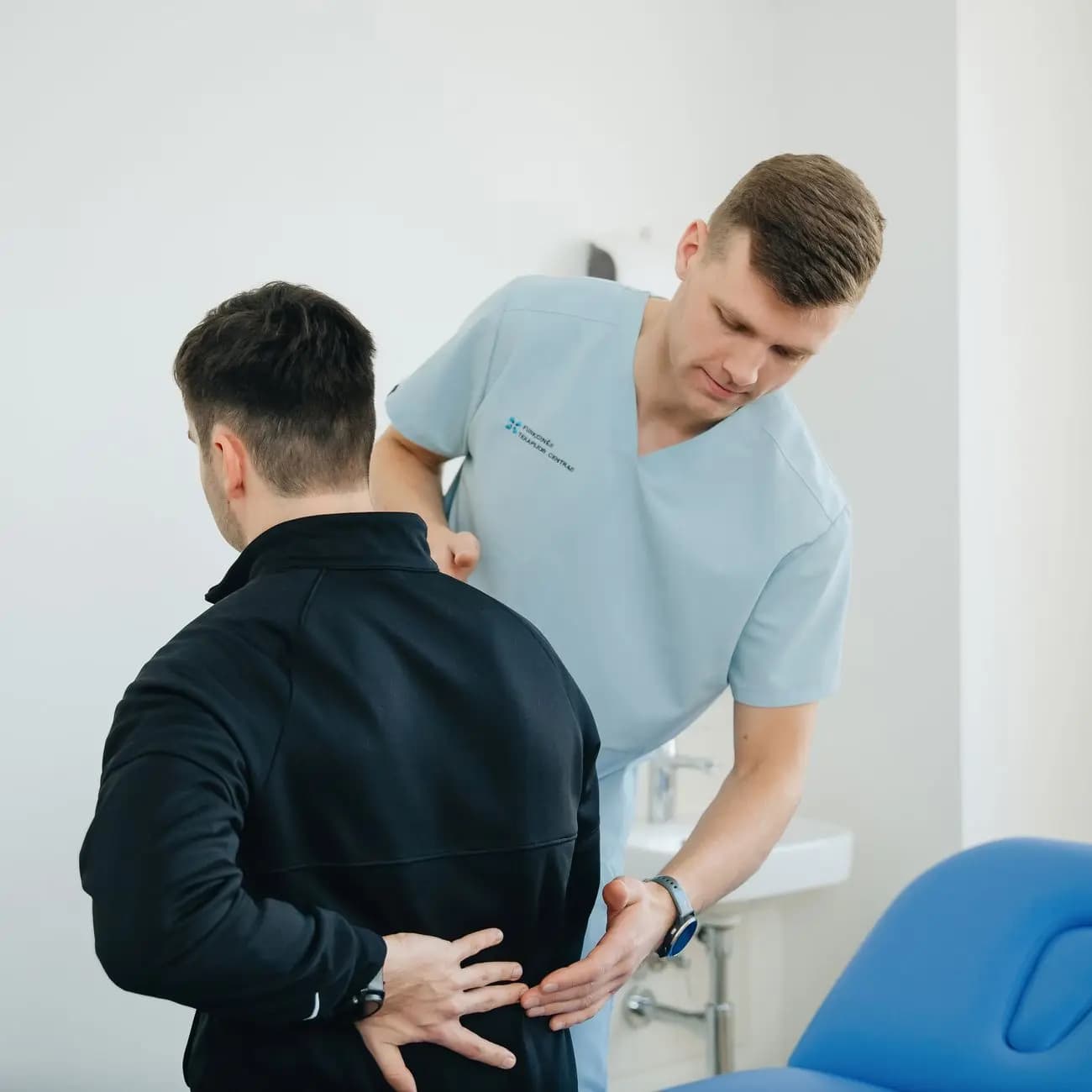
Lower-crossed syndrome (LCS) — Janda’s classic pattern of tight iliopsoas + rectus femoris + erector spinae with weak deep abdominals + glutes — produces anterior pelvic tilt, exaggerated lumbar lordosis and chronic mechanical low-back pain. Pro Physiotherapy Bangalore’s 3-phase corrective protocol (Assess → Release → Reactivate) restores neutral pelvic position in 8-12 sessions. From ₹549 (clinic) / ₹799 (home).
Lower-crossed syndrome is Janda’s classic muscle-imbalance pattern seen in almost every desk-bound Bengaluru IT professional: tight hip flexors (iliopsoas + rectus femoris) and thoracolumbar erector spinae combined with inhibited deep abdominals (transverse abdominis) and gluteus maximus + medius. The result is anterior pelvic tilt, exaggerated lumbar lordosis, a protruding belly, and chronic mechanical low-back pain that gym workouts can’t fix because they typically reinforce the tight groups and ignore the weak ones. Our 3-phase corrective protocol — Janda muscle-length testing (Page 2010) → myofascial release + PIR of tight structures → Cochrane-endorsed motor-control reactivation of glutes + deep core (Saragiotto 2016) — restores neutral pelvic position in 8-12 sessions. Sessions ₹549 (clinic) / ₹799 (home).
The Three-Phase Lower-Crossed Syndrome Corrective Protocol
Phase 1 — Diagnose the pattern. A 45-minute Session 1 assessment covers Thomas test (iliopsoas + rectus femoris length), Ober test (TFL / ITB), modified Trendelenburg (gluteus medius endurance), Sorensen back-extensor endurance, curl-up test (deep abdominal endurance), craniovertebral-angle photography, and anterior pelvic tilt angle measurement using an inclinometer. This objective baseline lets us prove — not guess — that LCS is your driver. Most Bengaluru desk workers we see have ≥ 5 of 6 positive tests.
Phase 2 — Release the tight chain (sessions 2-4). Manual therapy focuses on iliopsoas myofascial release, rectus femoris and TFL soft-tissue work, thoracolumbar erector inhibition via post-isometric relaxation (PIR), and Maitland grade III-IV mobilisation of the L4-L5 and L5-S1 zygapophyseal joints. Patients get a home-programme of quadruped rocking, half-kneeling hip-flexor stretch (with pelvic-tuck cue), and thoracic foam-roller extension. Phase 3 — Reactivate the weak chain (sessions 5-12). This is where most gym-based programmes fail because they load the pattern instead of fixing it. Our protocol drives the highest-evidence exercises for glute + deep-core activation — glute bridge, single-leg glute bridge, clam-shell, hip abduction with band, dead bug, bird dog, and side plank — progressed via Cochrane 2016 motor-control principles and Kendall 2015 hip-abductor loading data. Reassessment every 4 sessions with the same 6-test battery. Typical result: pelvic-tilt angle normalised by session 8, back-pain VAS down 70% by session 10.
Transparent Pricing — From ₹549
No hidden fees · Insurance-reimbursableEvery session receipt carries ICD-10 codes accepted by Star Health, HDFC ERGO, ICICI Lombard, Care Health, Aditya Birla and Manipal Cigna for reimbursement. Outer-perimeter home visits carry a transparent ₹150 surcharge.
“Great experience at Pro Physiotherapy, JP Nagar 8th Phase. The doctor is excellent, and his team is very supportive. Really happy with the care for my back. Highly recommended!”
Frequently Asked Questions
What is lower-crossed syndrome?
How is LCS different from just "having back pain"?
Can I fix lower-crossed syndrome with gym workouts?
How long does treatment take?
Do you offer this at home?
Book a clinical consultation at Pro Physiotherapy JP Nagar
FIFA-diploma-led team · 945+ verified 5★ Google reviews · Same-day slots · Transparent pricing.
Clinical evidence cited in this article
- Page P, Frank CC, Lardner R (2010). Approaches to the diagnosis and evaluation of low back pain: Janda muscle imbalance. Book chapter · Human Kinetics. https://pubmed.ncbi.nlm.nih.gov/20191394/
- Saragiotto BT, Maher CG, Yamato TP, et al. (2016). Motor-control exercise for chronic non-specific low back pain. Cochrane Database Systematic Reviews. https://pubmed.ncbi.nlm.nih.gov/26742533/
- Kendall KD, Emery CA, Wiley JP, Ferber R (2015). Effect of hip abductor strengthening on chronic mechanical low back pain: RCT. PM&R · 7(10): 1050-1057. https://pubmed.ncbi.nlm.nih.gov/25978936/