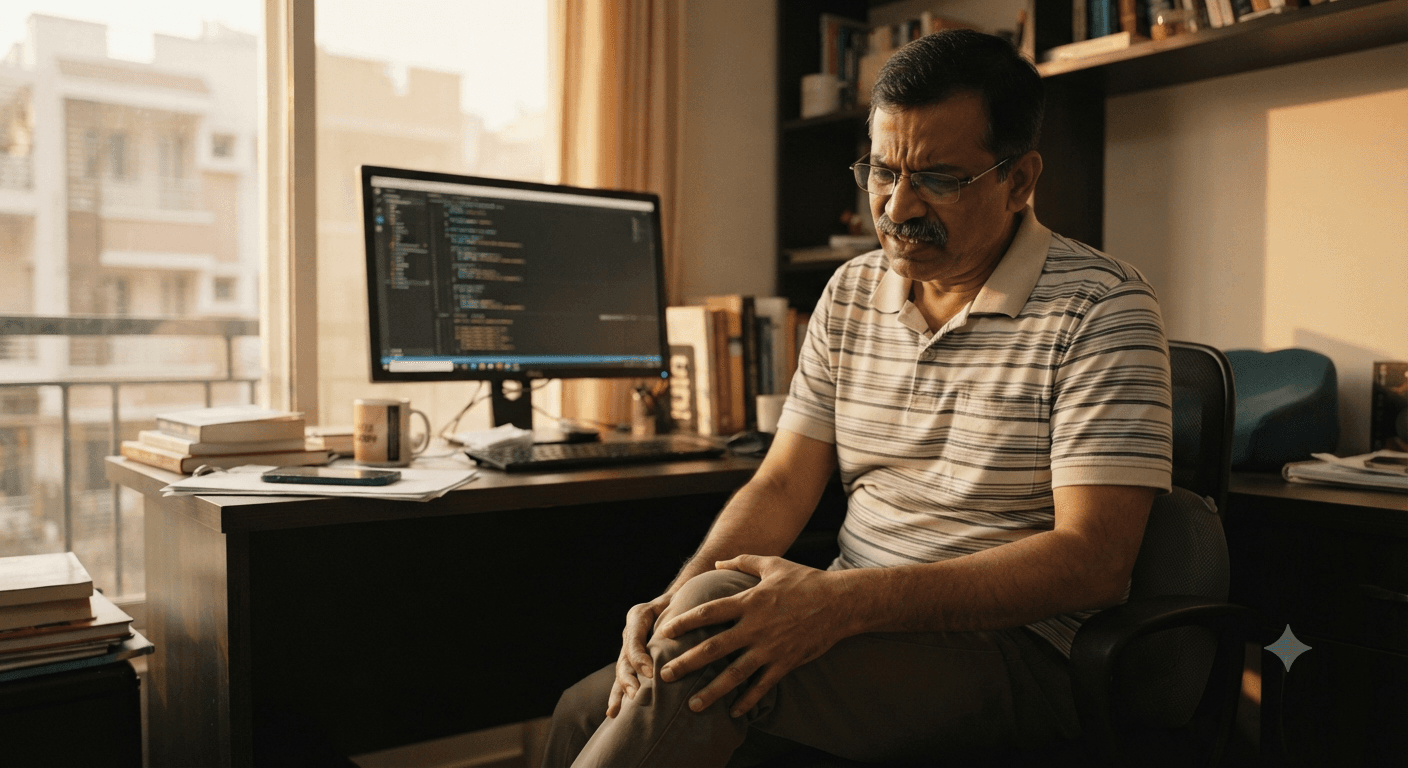
Patellofemoral pain syndrome (PFPS) — popularly known as “runner’s knee” — accounts for up to 25% of all knee-pain consultations at our JP Nagar clinic. Consequently, a rigorous, biomechanical-first patellofemoral pain syndrome treatment Bangalore athletes rely on at Pro Physiotherapy is drawn from the peer-reviewed literature and the 2018 International Patellofemoral Pain Consensus (BJSM).
Why PFPS Is a Hip Problem, Not a Knee Problem
Firstly, decades of imaging research show that PFPS rarely involves cartilage damage. Consequently, the modern evidence-based framework attributes symptoms to abnormal patellar tracking driven by hip weakness — particularly of the gluteus medius and external rotators — combined with faulty landing mechanics.
Diagnostic Framework
- Anterior knee pain with stairs, squatting, prolonged sitting (“movie-goer’s sign”).
- Pain aggravated by running, especially downhill.
- Crepitus without effusion.
- Positive Clarke’s sign, patellar grind.
- Negative special tests for meniscus, ACL, PCL.
Our 12-Week Biomechanical Rehab Protocol
1. Pain modulation1–2Ice, taping, load reduction, quadriceps isometrics 2. Hip & core3–6Progressive glute med / max loading, side plank series 3. Neuromuscular7–10Single-leg squat, step-down, drop-landing training 4. Return-to-run11–12+Graded return-to-run programme, gait re-educationHome Exercises That Actually Work
- Side-lying hip abduction with band — 3 sets of 15.
- Clamshell with band — 3 sets of 15.
- Wall sits — 3 sets of 30 seconds.
- Terminal knee extensions with band — 3 sets of 15.
- Single-leg glute bridge — 3 sets of 12 each leg.
Gait Re-Training for Bangalore Runners
Additionally, high-cadence gait re-training (aim > 170 steps per minute) reduces peak patellofemoral joint stress by up to 20% in real-time studies. Furthermore, our video gait analysis identifies overstriding, contralateral hip drop, and knee-valgus patterns — the three biggest contributors to Bengaluru runners’ PFPS presentations.
Home Visits Across Bengaluru Running Circuits
Consequently, we run same-week home-visit programmes for runners across Cubbon Park, Sankey Tank, Kanteerava Stadium, Turahalli Forest and Bannerghatta trail circuits. Additionally, our sports injury rehab centre and plantar fasciitis service serve as pillar hubs for running-related injuries.
Frequently Asked Questions
How long does patellofemoral pain syndrome treatment in Bangalore take?
Most cases resolve in 8–12 weeks of structured hip-and-quad rehabilitation with a graded return-to-run programme.
Do I need an MRI for runner’s knee?
No. PFPS is a clinical diagnosis. MRI is only warranted if the pain is atypical or fails to respond to structured rehabilitation.
Can I keep running with runner’s knee?
Yes, at reduced volume with cadence modification. Complete rest is not required and often prolongs the deconditioning cycle.
Are custom orthotics necessary?
Occasionally. For runners with clear pronation and refractory PFPS, custom orthotics complement hip-strengthening for 3–6 months.
What is the cost of runner’s knee treatment in Bangalore?
Sessions start at ₹800. A full 12-week runner’s knee rehabilitation package is quoted transparently after Day-1 assessment.
Run pain-free again. Book the biomechanical patellofemoral pain syndrome treatment Bangalore runners trust. Reserve your assessment →
Understanding the Role of Biomechanics in Patellofemoral Pain Syndrome Treatment
When addressing patellofemoral pain syndrome treatment in Bangalore, it’s essential to understand the intricate relationship between biomechanics and knee health. This understanding not only aids in effective treatment but also empowers patients with knowledge about their condition. At Pro Physiotherapy, we emphasize a holistic approach that considers not just the knee but the entire kinetic chain, including the hips, core, and even foot mechanics.
The Importance of Foot Mechanics
Foot mechanics play a crucial role in the development and treatment of patellofemoral pain syndrome. Flat feet or high arches can lead to improper alignment and excessive stress on the knee joint. A comprehensive assessment of foot posture and function is vital in our treatment protocol. Here are some key points regarding foot mechanics:
- Arch Support: Custom orthotics may be recommended to provide the necessary support and improve alignment.
- Foot Strengthening: Exercises targeting foot intrinsic muscles can enhance stability and reduce knee strain.
- Gait Analysis: Our gait analysis helps identify any abnormalities in foot strike patterns that could exacerbate knee pain.
Integrating Core Stability in Treatment
Core stability is another critical aspect often overlooked in treating patellofemoral pain syndrome. A strong core supports proper alignment and movement patterns, which can alleviate pressure on the knees. Here’s how core stability contributes to effective treatment:
- Pelvic Control: A stable pelvis ensures optimal alignment of the lower extremities, reducing the risk of knee pain.
- Functional Strength: Exercises like planks and bridges not only strengthen the core but also promote better movement mechanics.
- Balance and Coordination: Improved core strength enhances overall balance, which is crucial for runners and active individuals.
By integrating core stability exercises into the patellofemoral pain syndrome treatment in Bangalore, we can help patients achieve better outcomes and prevent future injuries.
Patient Education and Self-Management
At Pro Physiotherapy, we believe that patient education is a cornerstone of effective rehabilitation. Understanding the nature of patellofemoral pain syndrome empowers patients to take an active role in their recovery. Here are some self-management strategies we recommend:
- Activity Modification: Learn to modify activities that exacerbate knee pain, such as running on uneven surfaces.
- Regular Stretching: Incorporate stretching routines for the quadriceps, hamstrings, and calves to maintain flexibility.
- Strength Training: Engage in regular strength training focusing on the hips and legs to support knee function.
For more tailored advice, consider booking a session with our expert physiotherapists. You can find more information on our services or book an appointment.
In conclusion, patellofemoral pain syndrome treatment in Bangalore requires a multifaceted approach that encompasses biomechanics, core stability, and patient education. By addressing these areas, we can significantly enhance recovery outcomes and promote long-term knee health. For further reading on biomechanics and knee pain, refer to this NIH article.
Frequently Asked Questions
What are the common symptoms of patellofemoral pain syndrome?
Common symptoms of patellofemoral pain syndrome (PFPS) include anterior knee pain, particularly during activities like climbing stairs, squatting, or prolonged sitting. Patients often report pain during running, especially downhill, and may experience a sensation of crepitus or grinding in the knee without swelling. These symptoms can significantly impact daily activities and athletic performance.
How is patellofemoral pain syndrome diagnosed?
Patellofemoral pain syndrome is diagnosed through a clinical assessment that includes a physical examination and patient history. Key indicators include anterior knee pain during specific activities, positive tests like Clarke’s sign, and the absence of signs indicating meniscus or ligament injuries. A thorough evaluation by a physiotherapist can help identify the underlying biomechanical issues contributing to the pain.
What is the recovery time for patellofemoral pain syndrome treatment?
Recovery time for patellofemoral pain syndrome varies, but most patients see significant improvement within 8 to 12 weeks with appropriate treatment. A biomechanical rehabilitation protocol focusing on hip and core strengthening, along with gait retraining, can resolve symptoms in about 80% of cases. Regular follow-ups with a physiotherapist can help ensure a successful recovery.
Can patellofemoral pain syndrome be treated without surgery?
Yes, patellofemoral pain syndrome can typically be treated without surgery. A biomechanical approach, focusing on strengthening hip muscles and correcting movement patterns, addresses the root causes of the pain. Most patients experience relief through targeted rehabilitation programs, such as those offered at Pro Physiotherapy Bengaluru, which emphasize non-invasive treatment methods.