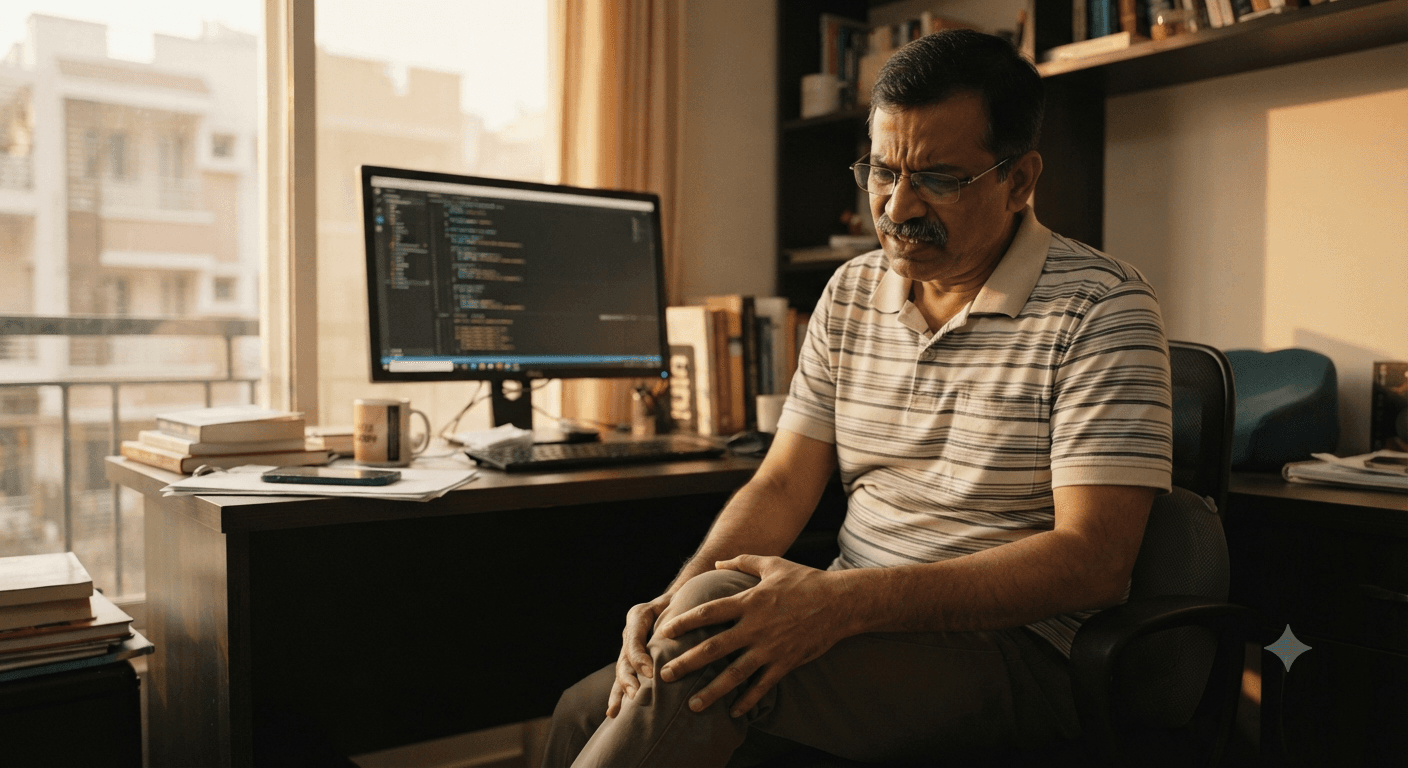
Whether you sit through nine-hour workdays in Whitefield, jog along Cubbon Park in the mornings, or manage the stairs of a fourth-floor JP Nagar apartment, knee pain has a way of dominating your life once it appears. If you are searching for knee pain physiotherapy near me in Bangalore, this guide translates current clinical evidence into a practical recovery roadmap.
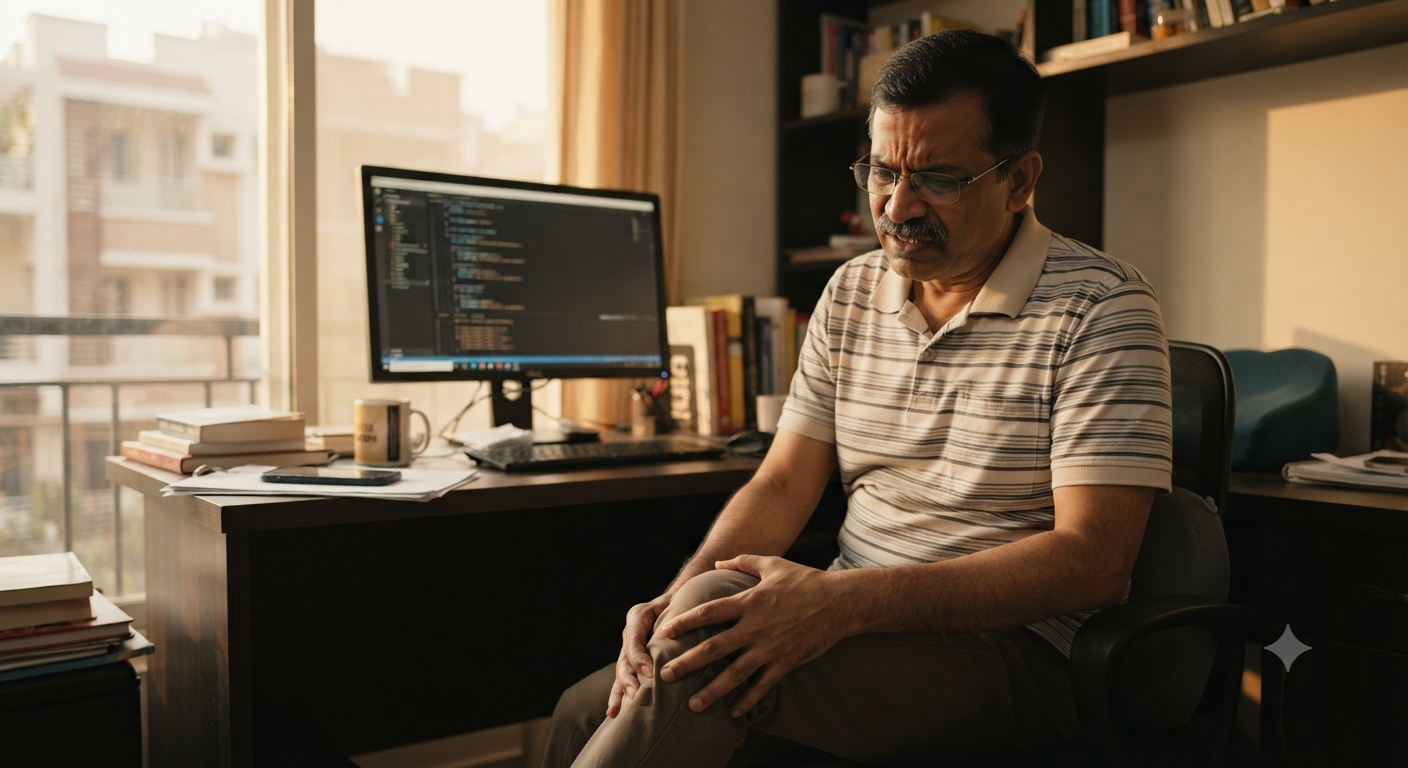
Knee pain is one of the top three musculoskeletal complaints for which Indians seek physiotherapy. It also has one of the most favourable non-surgical prognoses when addressed early with the right treatment framework. Below, we review what causes it, how a proper assessment should be conducted, and what a modern, evidence-based rehabilitation plan looks like.
Why Knee Pain Is So Common in Bangalore
Bangalore’s adult population sits at the intersection of two contradictory demands: prolonged sedentary work, and periodic bursts of high-impact exercise on weekends. This pattern is a well-known risk profile for patellofemoral pain syndrome, iliotibial-band syndrome, and early tibiofemoral osteoarthritis. A comprehensive review of patellofemoral pain risk factors published on PubMed Central identified weak hip abductors, quadriceps imbalance, and rapid mileage increases as the strongest modifiable factors.
The Five Most Common Diagnoses We See
- Patellofemoral pain syndrome (PFPS) — anterior knee pain worsened by squatting, stair descent, and sitting for long periods.
- Iliotibial-band syndrome — lateral knee pain in runners and cyclists.
- Meniscal irritation and degenerative tears — sharp mechanical pain with twisting.
- Early tibiofemoral osteoarthritis — morning stiffness, activity-related soreness, and swelling after long walks.
- Post-ACL or post-TKR rehabilitation — structured recovery after surgery.
A Proper Knee Physiotherapy Assessment
An evidence-based assessment lasts 45 to 60 minutes and includes the following components. If a nearby clinic skips these steps and prescribes exercises within ten minutes, its treatment quality is unlikely to be reliable.
1. Detailed Clinical History
Onset, duration, aggravating and easing factors, previous imaging, occupation, sport, and prior injuries.
2. Regional Screening
The knee is a hostage joint. Hip weakness, poor foot posture, and lumbar dysfunction routinely cause secondary knee pain. A responsible physiotherapist screens the entire lower kinetic chain.
3. Special Tests
Depending on your presentation, we may perform Lachman’s test, anterior/posterior drawer, McMurray’s, Thessaly, patellar apprehension, and grind tests.
4. Objective Strength and Balance Benchmarks
We use hand-held dynamometry for isolated quad, hamstring, and hip-abductor strength, plus the single-leg squat test and Y-Balance test for dynamic control.
5. Gait and Movement Analysis
For runners and hikers, 2D video gait analysis on our treadmill reveals overstriding, knee-valgus collapse, and hip-drop — the mechanical faults driving most overuse knee pain.
Evidence-Based Rehabilitation Framework
Contemporary rehabilitation for the most common knee conditions follows a stage-based hip-dominant model. Older “just do quad-sets” protocols have been superseded by proximal-strength programmes because the hip is the primary driver of patellar tracking and lower-limb alignment.
Phase 1 (Weeks 1–2): Pain and Swelling Control
- Relative rest — reduce, not eliminate, high-impact loading.
- Ice application 15–20 minutes after activity, up to 3 times daily.
- Gentle isometric quadriceps sets at 45° flexion.
- Side-lying clamshells and hip-abductor activation.
- Soft-tissue release of ITB, quadriceps, and calves.
Phase 2 (Weeks 3–4): Strength and Control
- Single-leg glute bridges, 3 x 12 per side.
- Step-ups (10–15 cm) with slow eccentric lowering.
- Terminal knee extensions with resistance band.
- Wall sits progressing 15 → 45 seconds.
- Lateral band walks and monster walks for hip external rotators.
Phase 3 (Weeks 5–8): Function and Load Progression
- Split squats and reverse lunges with modest external load.
- Step-downs and low-box drops for eccentric knee control.
- Single-leg balance with reach progressions.
- Return-to-run programme with 10% weekly load progression, if applicable.
Phase 4 (Weeks 9–12): Return to Sport or Full Function
- Sport-specific drills (change-of-direction, plyometrics).
- Isokinetic strength testing to ensure quadriceps and hamstring symmetry.
- Return-to-run and return-to-sport testing benchmarks.
Special Considerations for Osteoarthritis Patients
For adults over 45 with early tibiofemoral or patellofemoral osteoarthritis, the OARSI and NICE guidelines both recommend supervised exercise therapy as the first-line treatment, ahead of long-term pharmacological or surgical options. Reference reading is available at Physiopedia’s knee osteoarthritis resource.
Our osteoarthritis programme combines aquatic therapy where available, land-based strengthening, weight-management counselling, and orthotic screening. Sessions are structured across 8–12 weeks with clear reassessment points.
Post-Surgical Knee Rehabilitation
Our team supports patients recovering from ACL reconstruction, meniscal repair, partial knee replacement, and total knee arthroplasty. Recovery protocols are matched to the specific surgical technique and to the operating surgeon’s notes. Home-visit physiotherapy is available across South Bangalore to reduce the post-operative swelling that a long car ride typically causes.
What to Expect at Your First Consultation
Your first session at Pro Physiotherapy JP Nagar lasts about 45 minutes. It includes clinical history, examination, an explanation of the working diagnosis in plain language, and a written home programme. You will leave with two to four prescribed home exercises and a scheduled follow-up.
Additional information about our specialists is available on the team page. Home-visit sessions can be booked directly through our online scheduler.
Common Mistakes That Delay Knee Recovery
Certain patterns repeatedly delay recovery in our Bangalore knee-pain patients. Firstly, complete rest for more than 48 hours weakens the quadriceps and worsens patellar tracking. Movement is medicine, but graded movement is essential.
Secondly, self-prescribed heavy squats or lunges during flare-ups often provoke inflammation. Load must match tissue tolerance. Thirdly, over-reliance on painkillers masks the underlying biomechanical fault. Pain reduction without rehabilitation almost always leads to recurrence within six months.
Fourthly, buying an off-the-shelf knee brace before an assessment can be counterproductive. Braces have specific indications (patellar tracking correction, meniscal offloading, post-surgical stability) and are not a universal remedy. Fifthly, resuming full running mileage before achieving objective strength benchmarks is the leading cause of recurrent knee pain in Bangalore’s weekend-warrior population.
Finally, stopping physiotherapy the moment pain reduces is one of the most common errors. Neuromuscular control and load tolerance take longer to normalise than pain itself. Discharge should always be criterion-based, not calendar-based.
Frequently Asked Questions
How do I find good knee pain physiotherapy near me in Bangalore?
Look for KSPTC-registered physiotherapists with a documented assessment framework, transparent progress benchmarks, and home-visit availability. Ask specifically about hip-strengthening protocols, which are the current standard of care for most non-traumatic knee pain.
How many sessions will I need for knee pain?
Most non-surgical knee pain responds within 6–10 supervised sessions across 6–8 weeks. Post-surgical rehabilitation typically runs 10–12 weeks, with progression criteria set at every 2–3 weeks.
Can knee osteoarthritis be treated without surgery?
Yes, in most early and moderate cases. Supervised exercise therapy is the internationally recommended first-line treatment. Weight management, footwear correction, and quadriceps/hip strengthening produce durable pain reduction and improved function in more than 70% of patients.
Is it safe to run with knee pain?
Often yes, at reduced volume and intensity, provided you are cleared by a physiotherapist. Our clinicians will design a modified running plan so fitness is preserved while irritated tissues heal.
Do I need an MRI before starting physiotherapy for knee pain?
Not in most cases. A skilled physiotherapist can differentiate mechanical and inflammatory causes clinically. MRI is reserved for suspected ligament tears, complex meniscal injuries, or unresolved symptoms after 4–6 weeks of care.
Restore your knees, protect your future mobility. Book a comprehensive knee assessment with a physiotherapy team Bangalore’s active adults trust. Schedule your consultation today →


