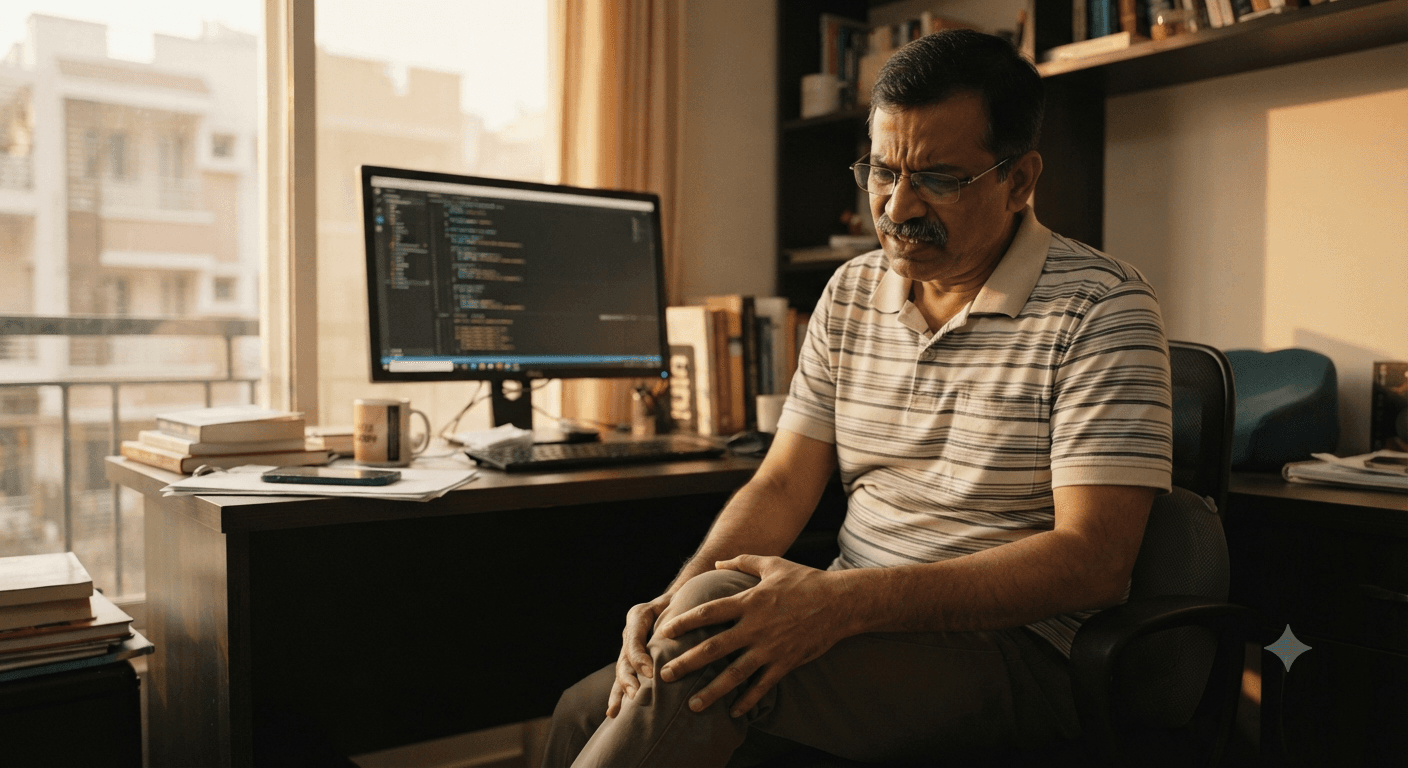
Every third patient at our Bangalore clinic in the past year has walked in with one complaint: “my knee just doesn’t feel the same anymore.” If you’re over 40 and starting to feel stiffness climbing stairs, discomfort after long walks, or that ominous “click” when standing up — this knee pain physiotherapy Bangalore guide is written for you. And more importantly, it can prevent your knee from becoming the reason you stop doing the things you love.
Why Knees Start Complaining After 40
By your fourth decade, several changes begin quietly in your knee joint:
- Cartilage thickness reduces by an average of 5% per decade after 30
- Synovial fluid production decreases, reducing joint lubrication
- Quadriceps strength declines by 1–2% per year after 40 without exercise
- Body weight typically increases 5–10 kg between 30 and 50, adding 25–50 kg of compressive load per step
- Bengaluru’s traffic + sedentary lifestyle accelerates this trajectory
Add prolonged sitting (Bangalore’s tech-hub reality), poor squatting posture during daily activities, and neglect of leg-strengthening exercises — and you’ve got the perfect storm for early knee osteoarthritis.
The 5 Most Common Types of Knee Pain We Treat
1. Osteoarthritis (Wear-and-Tear)
The most common. Deep, aching pain that worsens after long walks or descending stairs. Often accompanied by morning stiffness lasting under 30 minutes.
2. Patellofemoral Pain Syndrome (Runner’s Knee)
Pain around or behind the kneecap, especially when squatting, running downhill, or sitting for long periods. Common in fitness enthusiasts 35+.
3. Meniscus Injuries
Sharp pain, sometimes with a “locking” sensation. Often from a twist or squat gone wrong. May cause swelling within 24 hours.
4. Iliotibial Band Syndrome
Pain on the outer knee, common in runners and cyclists. Feels sharper during activity, eases with rest.
5. Bursitis (Kneeler’s Knee)
Swelling in front of the kneecap. Common in professions requiring prolonged kneeling (mechanics, floor cleaners, gardeners).
The Recovery Roadmap: 4 Progressive Phases
Every successful recovery follows a predictable pattern. Skip a phase, and you’ll likely re-injure. Here’s our clinical framework:
Phase 1: Pain Reduction (Weeks 1–2)
The goal isn’t “no pain” — it’s “controlled pain that allows movement.”
- Manual therapy: patellar mobilization, quadriceps release
- Ice/compression protocol (ICE) if swelling present
- Isometric quad sets and glute activation drills
- Modified daily activities (avoiding aggravators, keeping mobility)
Phase 2: Range and Strength (Weeks 3–5)
Restoring the “lost” range of motion and rebuilding the weakened stabilizers:
- Progressive knee-bend exercises (heel slides, wall slides)
- Straight-leg raises, mini-squats, step-ups
- Hip abductor and adductor strengthening (crucial — often skipped)
- Calf and hamstring flexibility work
Phase 3: Functional Movement (Weeks 6–8)
Preparing you for real-life activities:
- Squats with proper form (knee-tracking-toes)
- Lunges and single-leg balance training
- Stair-climbing drills and controlled descents
- Sport-specific movements if you’re an athlete
Phase 4: Prevention (Ongoing)
Maintaining what you’ve rebuilt:
- 15-minute daily strength routine
- Weekly walking targets and low-impact cardio
- Weight management strategies (crucial for OA cases)
- Regular follow-ups every 3–6 months
The Science: What Studies Show
A landmark 2023 BMJ meta-analysis reviewed 45 randomized trials on knee osteoarthritis treatment. The results were striking:
- Physiotherapy achieved equal or better outcomes than corticosteroid injections at 12 months
- Structured exercise programs delayed knee replacement surgery by an average of 7.4 years
- Quadriceps-strengthening alone reduced pain scores by 32% within 12 weeks
Translation: quality knee pain physiotherapy in Bangalore isn’t just an alternative to surgery — often, it’s the better choice.
Your Home Knee-Care Routine (5 Minutes/Day)
These exercises are safe for most knee-pain sufferers. Start today:
Morning (2 minutes)
- Ankle pumps: 20 reps each foot
- Heel slides: 10 reps each leg
- Straight-leg raises: 10 reps each leg (hold 3 seconds at top)
Evening (3 minutes)
- Wall-sit against wall: 3 rounds of 20–40 seconds
- Standing calf raises: 15 reps, hold 2 seconds at top
- Single-leg balance: 30 seconds each side
Red Flags: When Home Care Isn’t Enough
Book professional knee pain physiotherapy Bangalore support if you notice:
- Pain persisting beyond 4 weeks despite home care
- Rapid swelling or warmth (possible infection or joint bleeding)
- Inability to bear weight comfortably
- Sudden locking or giving way of the knee
- Night pain that disturbs sleep
- Any accompanying fever or systemic symptoms
7 Bengaluru-Specific Lifestyle Tips
- Squat squatting. The Indian sitting habit accelerates knee arthritis — use a chair or low stool instead.
- Manage two-wheeler jarring. Bengaluru’s roads compound stress. Invest in a bike with shock absorption or reduce distances.
- Use elevator floors 3+. Frequent stair-climbing accelerates OA.
- Weight management. Every 1 kg lost reduces knee load by 4 kg per step.
- Vitamin D supplementation. Bengaluru’s indoor lifestyle contributes to deficiencies that worsen knee health.
- Regular walking on grass. Cubbon Park, Lalbagh, and JP Nagar’s green spaces are ideal.
- Proper footwear. Discard worn-out shoes; alignment starts at the feet.
Realistic Recovery Timeline
- Mild knee pain: Full recovery in 4–6 weeks
- Moderate osteoarthritis: 8–12 weeks for major improvement
- Post-meniscus repair: 6–12 weeks for return-to-sport
- Post-knee replacement: 3–6 months for full functional recovery
Why Our Knee Pain Physiotherapy in Bangalore Stands Out
Not every clinic offers the same standard of care:
- Senior physiotherapist with 15+ years focus on musculoskeletal cases
- Gait analysis using cutting-edge technology
- Individualized treatment plans (never a template)
- Direct coordination with orthopedic surgeons when needed
- Home-visit options for elderly patients — explore our services
Frequently Asked Questions
Can knee pain be reversed without surgery?
In 90% of cases, yes — especially for early to moderate osteoarthritis. Only advanced degeneration with severe pain and functional loss typically requires surgery.
How much does knee pain physiotherapy in Bangalore cost?
Costs vary by treatment complexity and duration. We provide transparent quotes after your initial assessment. Insurance-compatible invoices available.
Should I get an MRI before starting physiotherapy?
Usually not initially. We can start conservative care based on clinical examination. MRI may be recommended if pain doesn’t improve as expected.
Is running bad for arthritic knees?
Running is possible with proper form and gradual progression. In fact, moderate running is associated with lower arthritis rates in long-term studies. We can guide safe return-to-running.
How often will I need to visit?
Initial 2–3 sessions per week, tapering to once weekly, then monthly maintenance. Most patients complete active care within 8–10 sessions.
Your Knees Deserve Better Than Painkillers
Every day you postpone, your muscles get weaker and your pain patterns become more established. Knee pain physiotherapy in Bangalore isn’t about “dealing with it” — it’s about reclaiming your active life.
Book your knee assessment today or contact us. Your future self will thank you.