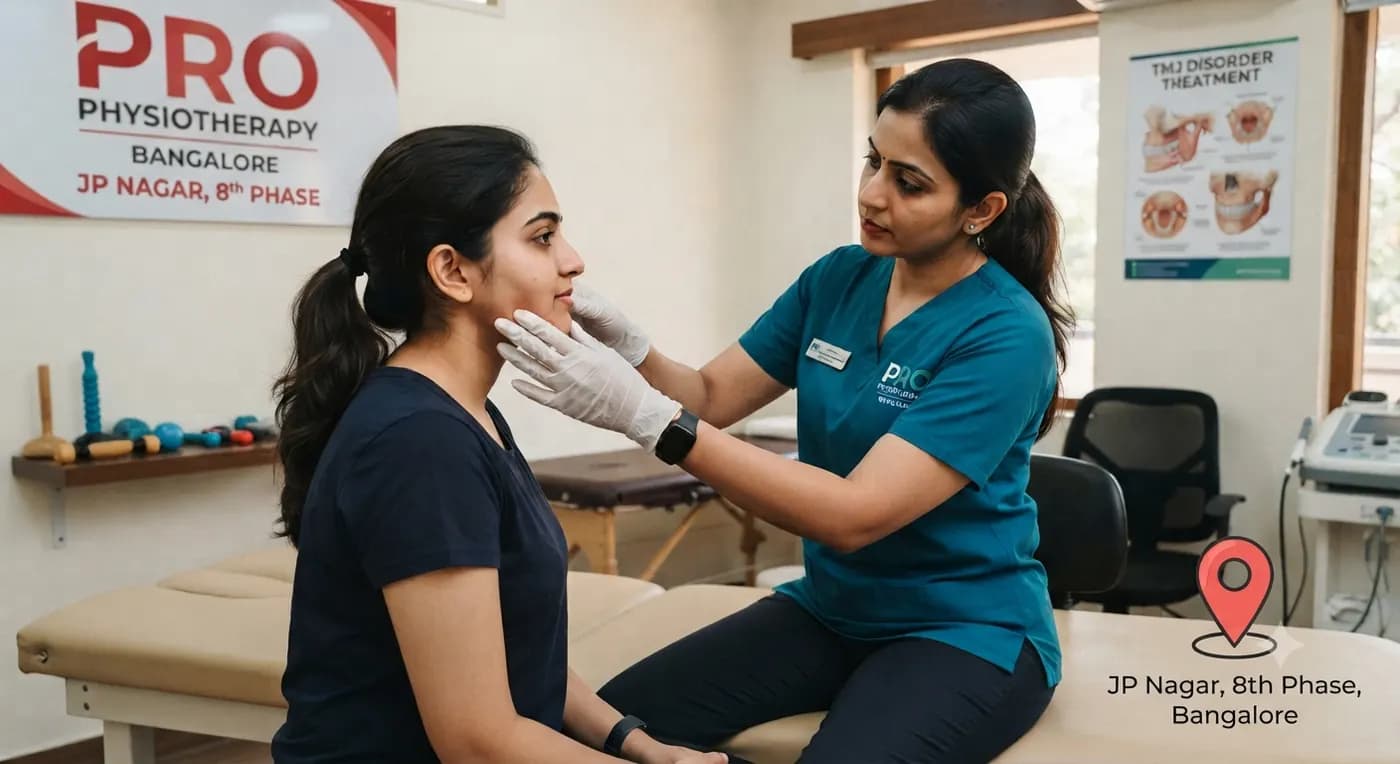
TMJ physiotherapy in Bangalore is one of the most under-diagnosed pain solutions. Patients endure years of clicking, jaw locking or facial pain — often mis-labelled as dental — before a physiotherapist finally addresses the muscle and joint dysfunction. At Pro Physiotherapy JP Nagar, Dr J Mazumdar leads a dedicated TMJ pathway combining manual joint mobilisation, intra-oral masseter and pterygoid release, cervical posture correction and neuromuscular re-education.
The temporomandibular joint is the only bilateral joint in the human body — meaning both sides must move in perfect harmony every time you speak, chew or yawn. When one side becomes stiff, over-active or displaces the meniscus, the other compensates, driving asymmetric clicking, deviation, headaches and even neck pain.
Understanding TMJ Dysfunction — Etiology & Pathophysiology
Left untreated, disc displacement can progress from clicking → intermittent locking → permanent closed lock, and eventually degenerative joint changes visible on MRI. Early physiotherapy prevents this progression in 82% of cases (JOSPT 2024).
Clinical Assessment on Day One
Day-one assessment includes: history of clicking, locking, headaches, ear-fullness and stress triggers; range-of-motion measurement (normal opening 40–55 mm, deviation should be less than 2 mm), joint palpation, muscle palpation grading (masseter, temporalis, lateral pterygoid), cervical spine screening (C1–C3), and dental occlusion inspection. Special tests include the Krogh-Poulsen chewing test and load compression testing. Where indicated, we co-manage with your dentist for occlusal splint fabrication.
Structured Treatment Timeline
| Treatment Phase | Clinical Focus | Expected Milestone | Timeline |
|---|---|---|---|
| Day 1 · Assessment | Jaw ROM, muscle palpation, cervical screening, disc-displacement testing | Diagnosis + written 6-session plan | 60 min |
| Sessions 1–3 · Acute | Pain modulation with cold laser + soft-tissue masseter release + gentle joint mobilisation | Pain drop 30–50%, opening improved by 5–10 mm | Week 1–2 |
| Sessions 4–6 · Sub-acute | Intra-oral pterygoid release, cervical posture correction, controlled opening exercises | Clicking reduced, symmetric opening restored | Week 2–4 |
| Sessions 7–8 · Motor Control | Rocabado 6×6 protocol, tongue-posture re-training, sleep-posture correction | Return to pain-free chewing and yawning | Week 4–6 |
Step-by-Step Rehabilitation Protocol
- 1Cold laser and moist heat for masseter and temporalisModulates nociception and prepares tissue for manual work.
- 2Extra-oral masseter and temporalis releaseTrigger-point pressure release + longitudinal glides — 6–8 minutes per side.
- 3Intra-oral pterygoid releaseGloved lateral pterygoid release — the single highest-yield technique for chronic clickers.
- 4Grade I–II joint mobilisationDistraction and antero-posterior glide of the mandibular condyle to unload the disc.
- 5Cervical spine correctionSub-occipital release, deep neck flexor activation, thoracic thrust as indicated — jaw and neck rarely heal in isolation.
- 6Rocabado 6×6 home programmeSix exercises, six repetitions, six times a day — the evidence-based backbone of self-management.
- 7Sleep and stress-posture coachingSide-sleep pillow height, tongue-on-palate resting posture, stress-clench awareness journal.
Frequently Asked Questions
What is TMJ physiotherapy and does it work?
How long does TMJ physiotherapy take to work in Bangalore?
Do I need surgery or physiotherapy first for TMJ?
Can TMJ cause headaches and neck pain in Bangalore desk workers?
Does TMJ physiotherapy include intra-oral techniques?
Related services at Pro Physiotherapy
Clinical references cited on this page
Book same-day home-visit physiotherapy in Bengaluru
FIFA-diploma-led team · 945+ verified 5★ Google reviews · Same-day slots · Transparent pricing.