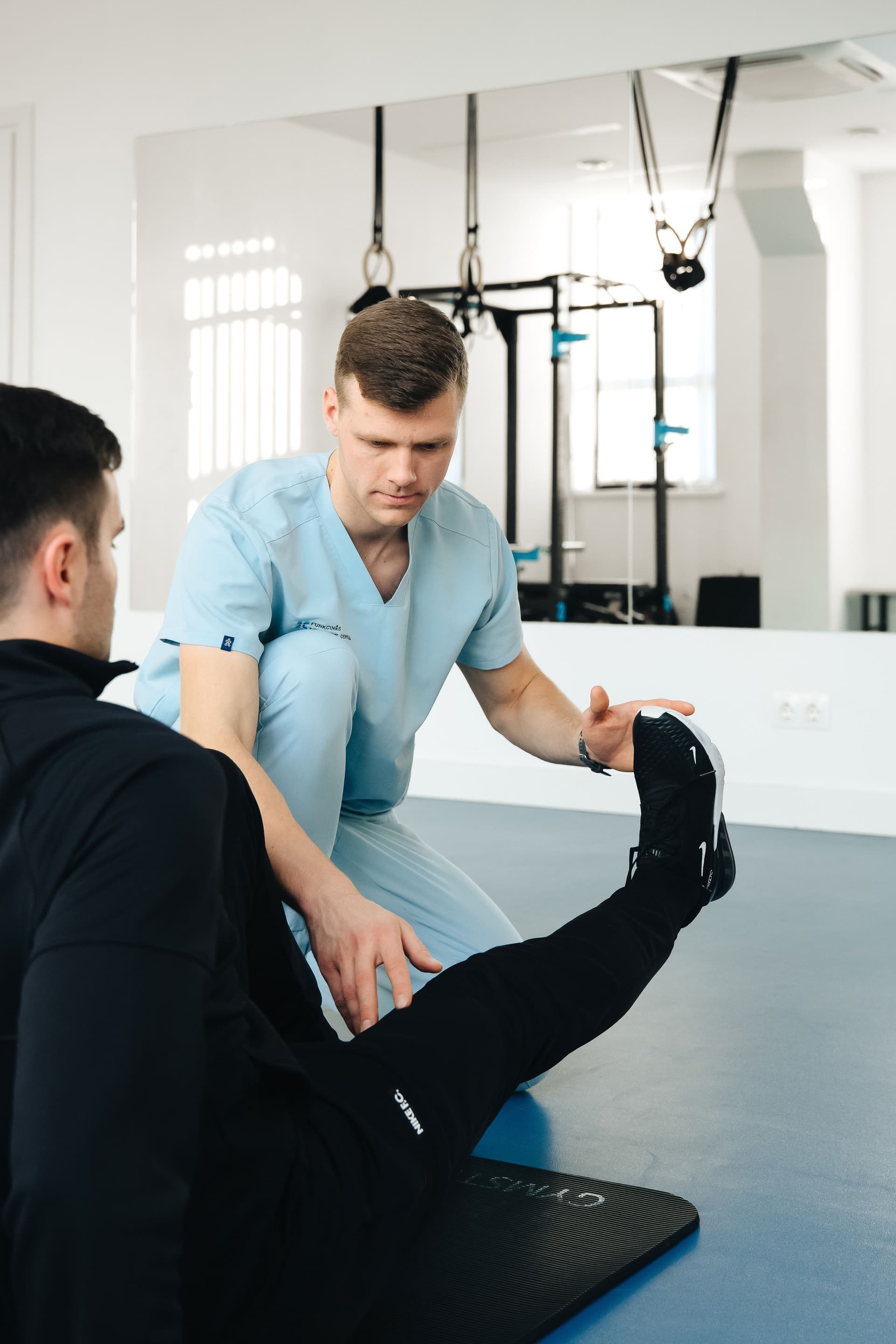
Published July 2026 · Reviewed by Dr. J Mazumdar, BPT (FIFA Sports Medicine Certified)
The short answer: A safe sports injury recovery timeline follows a criterion-based 5-phase framework — protect, restore mobility, rebuild strength, return-to-run, return-to-sport — spanning 6-14 weeks depending on the tissue and severity. Randomised trials (BJSM, JOSPT) show that delaying return-to-sport until strength symmetry reaches 90% and pain-free full range are met reduces re-injury risk by up to 84%. Consequently, skipping phases is the single biggest predictor of recurrent injury.
Table of Contents
- Why "time-based" recovery is outdated
- Tissue-healing biology by injury type
- The 5-phase sports injury recovery timeline
- Return-to-sport testing — the objective bar
- Typical timelines by common injury
- Red flags — when to slow down
- Bengaluru-specific recovery factors
- Coordinating physio + orthopaedic + strength coach
- FAQ
Why "time-based" recovery is outdated
For decades, the standard answer to "when can I play again?" was a fixed number of weeks. However, modern sports medicine has moved decisively toward a criterion-based sports injury recovery timeline — one that progresses each athlete only when specific objective tests are passed.
The reason is simple: tissue heals at its own pace. Two athletes with the same injury may need dramatically different timelines because of age, training history, adherence, sleep, nutrition, and psychological readiness. Consequently, forcing a calendar-based return has been shown to double or even triple re-injury rates in follow-up studies.
Tissue-healing biology — the biological floor
Although we individualise every plan, human tissue does have minimum healing windows. Understanding these prevents the most common "I felt fine, so I went back" mistake:
- Muscle strain (grade I-II): 2-6 weeks. Peak collagen remodelling continues to ~12 weeks.
- Ligament sprain (grade I-II): 4-12 weeks. Grade III (full tear) often 6-9 months with or without surgery.
- Tendon injury (tendinopathy): 8-24 weeks. Tendon collagen remodels slowly and requires progressive load.
- Bone stress fracture: 6-12 weeks in cortical bone, longer for high-risk sites like the femoral neck.
- Cartilage / meniscus repair: 12-24 weeks post-surgery, with limited running before 4 months.
- ACL reconstruction: 9-12 months for return-to-sport (Grindem et al., BJSM 2016).
The 5-phase sports injury recovery timeline
Below is the framework Pro Physiotherapy uses for every athlete, from weekend cricketers to elite footballers. Progression through each phase depends on criteria, not calendar dates.
Phase 1 — Protect & reduce (Day 0-14)
The first goal is to protect the injured tissue and reduce swelling. Consequently, we use the updated PEACE & LOVE protocol: Protection, Elevation, Avoid anti-inflammatories, Compression, Education — followed after 48 hours by Load, Optimism, Vascularisation and Exercise. Furthermore, we begin gentle isometric contractions early to preserve neuromuscular signalling.
Exit criteria: Minimal swelling, pain 0-2 / 10 at rest, ability to perform pain-free isometrics.
Phase 2 — Restore mobility (Week 2-4)
Next, we rebuild joint range of motion, tissue extensibility, and basic movement patterns. Techniques include manual therapy, myofascial release, joint mobilisation, and range-of-motion drills. Additionally, we start light aerobic cross-training (stationary bike, pool) to maintain cardiovascular fitness.
Exit criteria: Full pain-free range of motion; ability to walk 30 minutes without limp.
Phase 3 — Rebuild strength (Week 4-8)
Now we progressively load the injured tissue. Consequently, this is the most important phase — under-loading here creates the "silent weakness" that leads to re-injury months later. We use progressive resistance training, eccentric loading (especially for tendinopathies), single-leg strength work, and neuromuscular re-education.
Exit criteria: Limb Symmetry Index (LSI) ≥ 80% on strength tests. Pain-free full-effort resisted contraction.
Phase 4 — Return-to-run & power (Week 6-12)
At this point, athletes begin structured running progression, plyometrics, cutting drills, and sport-specific movement patterns. We use graded exposure — for example, straight-line jogging before change-of-direction, and controlled cutting before reactive cutting.
Exit criteria: Hop test battery LSI ≥ 90%. Pain-free plyometrics at full effort. Psychological readiness scale ≥ 8/10.
Phase 5 — Return-to-sport & performance (Week 10-16+)
Finally, we simulate full training, then match-play. Load and recovery are monitored closely to prevent post-return re-injury (the highest-risk 8-week window). Furthermore, an ongoing prevention program is prescribed — usually strength maintenance twice a week for the first 6 months back.
Exit criteria: Full training load, all sport-specific tests passed, athlete confidence high.
Return-to-sport testing — the objective bar
To progress from phase 4 to phase 5, we run a battery of objective tests. Passing all of them cuts re-injury rate by up to 84% (Grindem et al., BJSM 2016 — PMID: 27162233).
- Isokinetic strength testing: Quadriceps & hamstring symmetry ≥ 90%.
- Single-leg hop tests: Single, triple, crossover, and 6-metre timed hop, all ≥ 90% LSI.
- Y-balance test: Dynamic balance symmetry.
- Sport-specific field tests: Change-of-direction agility, sport-specific patterns.
- Psychological readiness: ACL-RSI or similar validated questionnaire.
Typical timelines by common injury
These are guidelines only. Your actual sports injury recovery timeline may be shorter or longer depending on grade, surgery, and adherence.
- Ankle sprain (grade I-II): 2-6 weeks to full sport.
- Hamstring strain (grade II): 4-8 weeks. Nordic hamstring exercises are critical.
- Rotator cuff tendinopathy: 8-14 weeks progressive load.
- Tennis elbow (lateral epicondylalgia): 8-16 weeks with eccentric wrist loading.
- Meniscus repair (post-op): 4-6 months to sport.
- ACL reconstruction: 9-12 months to pivot-sport play.
- Achilles tendinopathy: 12-24 weeks with heavy eccentric calf loading.
- Groin adductor strain: 4-10 weeks with Copenhagen exercises.
Red flags — when to slow down
Regardless of the phase, immediately pause progression and consult a physiotherapist if you experience:
- Sudden increase in pain the day after a session
- Return of swelling, warmth, or joint stiffness
- Sensation of instability or "giving way"
- Pain rating above 4/10 during any exercise
- Loss of previously achieved range of motion
Bengaluru-specific recovery factors
Bengaluru's climate, road surfaces, and gym infrastructure influence recovery in subtle but measurable ways. In particular, hard concrete roads and uneven pavements demand extra ankle-and-knee neuromuscular training before returning to outdoor running. Additionally, the city's booming amateur cricket, football, and CrossFit communities generate distinct injury profiles that we tailor the timeline for. Finally, monsoon-season humidity affects hydration and post-session recovery — we adjust load and sleep guidance accordingly.
Coordinating physio, orthopaedic, and strength coach
The best sports injury recovery timeline is a team effort. Our senior physiotherapists coordinate with orthopaedic surgeons across South Bengaluru for imaging, injections, or surgical opinions when required. Furthermore, once phase 4 begins, we hand-off carefully to your strength & conditioning coach, providing detailed load-tolerance targets and prevention exercises. Consequently, you return to sport confident that every link in the chain is aligned.
For related information on specific injuries, see our clinical guides on Sports Injury Rehabilitation and Post-Surgical Knee Recovery.
Frequently asked questions
How long is the typical sports injury recovery timeline?
For most soft-tissue injuries, 6-14 weeks from injury to full sport, spread across the 5 phases. However, ligament and bony injuries — especially ACL reconstruction or bone stress fractures — routinely need 6-12 months.
Can I speed up my recovery?
You cannot rush biological healing, but you can optimise every other factor: sleep (7-9 hours), protein intake (1.6-2.2 g/kg), progressive loading, and mental readiness work. Consequently, athletes who follow the plan tightly often finish at the lower end of the timeline range.
What is the single biggest predictor of re-injury?
Returning to sport before meeting objective criteria — particularly Limb Symmetry Index < 90% and psychological readiness < 7/10. Therefore, criterion-based testing is non-negotiable in modern rehab.
Do I need surgery to return to sport?
Not always. Many injuries — including some ACL tears, most meniscus tears, and nearly all tendinopathies — respond well to structured non-surgical rehab. See our detailed comparison: Physiotherapy vs Surgery for Knee Pain.
How does Pro Physiotherapy support Bengaluru athletes?
We deliver criterion-based, home-visit sports injury rehab across JP Nagar, Jayanagar, HSR Layout, Koramangala, and 40+ South Bengaluru localities. Our senior clinician is FIFA Sports Medicine certified. Book a home-visit assessment or call +91 89510 22334.
Ready to plan your recovery the right way? Explore our full 142-exercise library, read patient success stories, or book a home-visit assessment.


