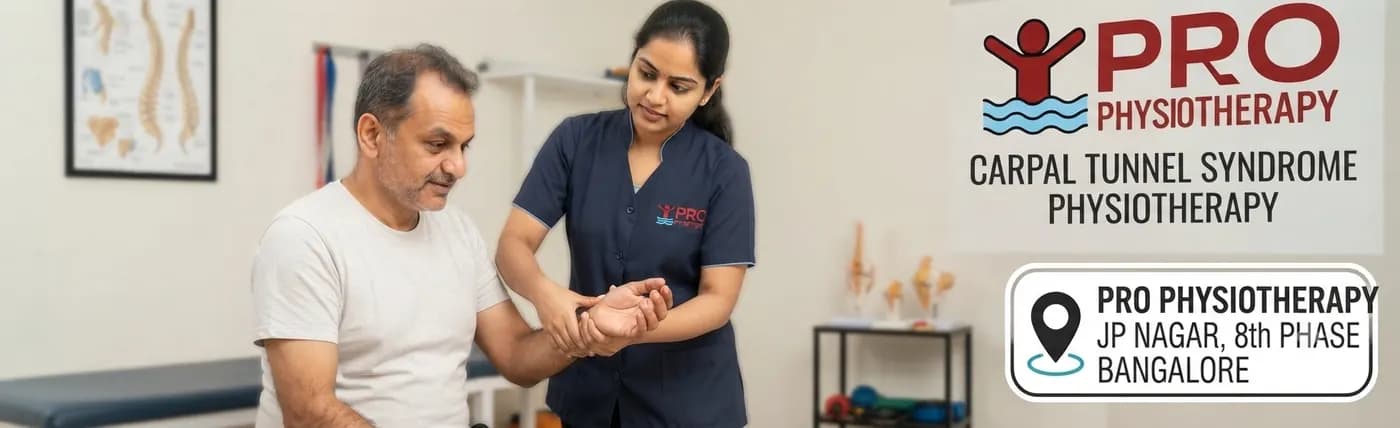
Carpal tunnel syndrome physiotherapy in Bangalore is now the first-line treatment for mild-to-moderate median nerve compression. Recent evidence from JOSPT (2024) and Cochrane (2023) shows that structured physiotherapy achieves clinical outcomes comparable to surgery at one-year follow-up — without the risks of scar tenderness, pillar pain or work absence. At Pro Physiotherapy JP Nagar, Dr J Mazumdar delivers a 6-step wrist-nerve relief pathway specifically designed for Bangalore's IT workforce.
Carpal tunnel syndrome is the most common entrapment neuropathy — the median nerve becomes compressed inside the tight bony-ligamentous carpal tunnel at the wrist. Patients report tingling in the thumb, index, middle and half of the ring finger — worse at night, often shaking the hand to relieve symptoms. Delaying treatment risks permanent thenar wasting and grip weakness.
Understanding Carpal Tunnel Syndrome — Anatomy & Risk Factors
Risk factors in the Bangalore cohort are dominated by IT-related repetitive strain: keyboard use above 6 hours per day, sustained wrist extension of over 30 degrees, non-neutral mouse position, and lack of micro-breaks. Diabetes, obesity, hypothyroidism and pregnancy add systemic risk. Nerve conduction studies grade severity as mild (sensory latency prolonged), moderate (motor latency prolonged), or severe (denervation on EMG).
Clinical Assessment on Day One
Day-one assessment: symptom severity using Boston Carpal Tunnel Questionnaire (BCTQ), Phalen's test, reverse Phalen's, Tinel's sign, Durkan's compression test, thenar muscle strength (0–5 grading), two-point discrimination, and monofilament sensation. We review any prior nerve conduction study report and rule out mimickers — cervical radiculopathy (C6), thoracic outlet syndrome, and pronator teres syndrome. Ergonomic workstation photographs are taken for correction planning.
Structured Treatment Timeline
| Treatment Phase | Clinical Focus | Expected Milestone | Timeline |
|---|---|---|---|
| Day 1 · Assessment | BCTQ score, provocation testing, NCS review, ergonomic photo audit | Severity graded + written 6–8 session plan | 60 min |
| Week 1–2 · Pain relief | Night splinting in neutral, ultrasound therapy, tendon glides, activity modification | Night pain reduced 40–60%, no more waking with numbness | 3 sessions |
| Weeks 3–5 · Nerve mobilisation | Median nerve glides, manual soft-tissue release, cervical spine correction | Numbness confined to symptom-provocative tasks only | 4 sessions |
| Weeks 6–8 · Return to function | Grip strengthening, ergonomic re-design, gradual typing exposure | BCTQ dropped by 50%+, work-full-time without symptoms | 2 sessions + written maintenance plan |
Step-by-Step Rehabilitation Protocol
- 1Neutral-wrist night splintCustom-fit or prefabricated splint holding the wrist at 0° extension. Worn nightly for 4–6 weeks — the single highest-yield intervention.
- 2Median nerve gliders (6-position sequence)Six-position nerve-tensioning progression — restores nerve excursion within the tunnel. Performed 2× per session and 3× daily at home.
- 3Tendon glide exercisesStraight → hook → fist → tabletop → straight fist. Increases synovial fluid circulation, reduces tenosynovitis pressure.
- 4Manual soft-tissue releaseInstrument-assisted release of the forearm flexor mass, pronator teres, and transverse carpal ligament margins.
- 5Cervical spine screening + treatmentThe "double crush" phenomenon means cervical C6 involvement adds to distal median symptoms. C-spine mobilisation is treated where indicated.
- 6Ergonomic workstation re-designChair height, monitor level, mouse type, wrist-rest use, hourly micro-break timer — engineered specifically for Bangalore IT workers.
Frequently Asked Questions
Can physiotherapy really avoid carpal tunnel surgery?
How long does carpal tunnel physiotherapy take?
Do I need to wear a wrist splint all day?
Is carpal tunnel connected to my neck posture?
Can I continue coding and using the mouse during treatment?
Related services at Pro Physiotherapy
Clinical references cited on this page
Book same-day home-visit physiotherapy in Bengaluru
FIFA-diploma-led team · 945+ verified 5★ Google reviews · Same-day slots · Transparent pricing.