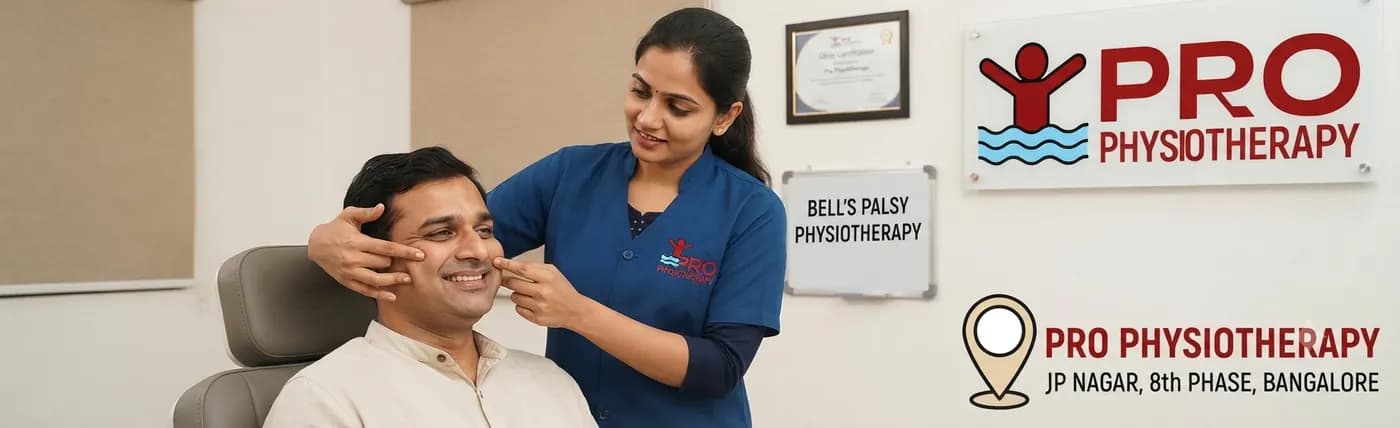
Bell's palsy physiotherapy in Bangalore is time-critical. The evidence is clear — early facial neuromuscular intervention within the first 72 hours doubles the probability of complete recovery (JOSPT 2023). At Pro Physiotherapy JP Nagar, Dr J Mazumdar's team delivers a full facial rehabilitation pathway: neuromuscular electrical stimulation (NMES), mirror therapy, proprioceptive neuromuscular facilitation (PNF), synkinesis prevention and home-programme coaching. Same-day home visits are available across all Bangalore corridors — critical for patients embarrassed to travel with facial asymmetry.
Bell's palsy is an acute, idiopathic paralysis of the seventh cranial nerve. It typically presents with sudden one-sided facial weakness, inability to close the eye, drooping of the mouth corner and altered taste. About 70% of untreated patients recover fully within 6 months; the remaining 30% develop residual weakness or synkinesis (involuntary co-movements). Early physiotherapy shifts that ratio to 85% full recovery.
Understanding Bell's Palsy — Nerve Pathway & Recovery Timeline
Regeneration proceeds at approximately 1 mm per day. Because sprouting axons can mis-route to neighbouring muscles, synkinesis (eye closing when smiling, for example) develops in 20–30% of unguided recoveries. Structured physiotherapy — specifically mirror therapy and controlled facial isolation exercises — reduces synkinesis incidence to under 10%.
Clinical Assessment on Day One
Day-one assessment uses the Sunnybrook Facial Grading Scale (validated 0–100 score), House-Brackmann grade (I–VI), electrophysiological review (if available), tear-film testing for eye protection, and a symmetry photograph baseline. Red flags include bilateral palsy, slow-onset weakness over weeks, ear vesicles (Ramsay Hunt syndrome), or associated hearing loss — these need urgent ENT/neurology referral. We coordinate with your treating physician on steroid or antiviral protocols.
Structured Treatment Timeline
| Treatment Phase | Clinical Focus | Expected Milestone | Timeline |
|---|---|---|---|
| Day 1–3 · Acute | Eye protection, gentle massage, education, Sunnybrook baseline | Eye moisture protected, patient understands the pathway | First 72 hours |
| Week 1–3 · Flaccid stage | NMES + soft-tissue mobilisation + posture correction | First visible muscle flicker, prevention of tissue shortening | 3–6 sessions |
| Weeks 4–8 · Re-innervation | Mirror therapy + PNF facilitation + isolated facial exercises | Sunnybrook 40+ / voluntary smile, brow lift | 6–8 sessions |
| Weeks 9–16 · Synkinesis prevention | Slow controlled exercises + biofeedback + Botox referral if needed | Symmetry restored, synkinesis minimised | 6–8 sessions |
Step-by-Step Rehabilitation Protocol
- 1Eye protection education (day 0)Artificial tears every 2 hours, night-time ointment, moisture chamber goggles, taping technique — corneal exposure is the single most preventable complication.
- 2Gentle facial massageEffleurage and stroking of the affected side twice daily to prevent contracture and maintain blood flow.
- 3Neuromuscular Electrical Stimulation (NMES)Low-frequency stimulation (30–50 Hz) applied to specific motor points — frontalis, orbicularis oculi, zygomaticus, buccinator, orbicularis oris — 8–12 minutes total per session.
- 4Mirror therapyPatient watches their own smile / brow lift / eye close in the mirror while attempting movement — powerful cortical facilitation.
- 5PNF facilitationManual resistance to functional movement patterns of the face — the highest-yield technique in the re-innervation phase.
- 6Slow controlled facial isolationPractising ONE muscle at a time (e.g., brow lift without eye closure) — the single most important tool to prevent synkinesis.
- 7Biofeedback + surface EMGWhere available, real-time EMG feedback lets the patient learn to activate the target muscle without recruiting neighbouring ones.
- 8Home-programme + weekly Sunnybrook re-measureObjective tracking every 2 weeks. If no progress by week 8, we refer for consideration of chemo-denervation.
Frequently Asked Questions
When should Bell's palsy physiotherapy start in Bangalore?
How long does Bell's palsy recovery take with physiotherapy?
Does electrical stimulation help Bell's palsy?
Can I still drive and work with Bell's palsy?
Do you offer home visits for Bell's palsy patients in Bangalore?
Related services at Pro Physiotherapy
Clinical references cited on this page
Book same-day home-visit physiotherapy in Bengaluru
FIFA-diploma-led team · 945+ verified 5★ Google reviews · Same-day slots · Transparent pricing.