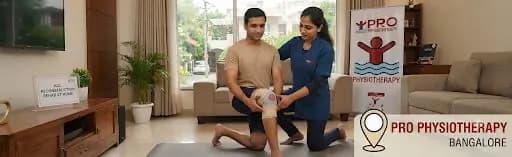
ACL reconstruction rehab at home in Bangalore is the fastest, safest and most convenient recovery pathway after ACL surgery — provided the protocol is criterion-based, evidence-informed, and coordinated with the operating surgeon. At Pro Physiotherapy JP Nagar, Dr J Mazumdar's ortho-sports team runs a proven 24-week return-to-sport programme that has helped hundreds of Bangalore ACL patients return to cricket, football, tennis and gym without re-injury.
The evidence is unambiguous: return-to-sport driven by time alone (6 months, 9 months) doubles the re-tear risk compared to criterion-based progression (BJSM 2024). Our protocol maps six objective tests — quadriceps strength symmetry, hop-test symmetry, drop landing quality, running gait, sport-specific cutting and psychological readiness — each of which must be passed before advancing to the next phase.
Understanding ACL Reconstruction & Recovery Physiology
Common early complications — arthrofibrosis, quadriceps shutdown, patellofemoral pain — are all preventable with appropriate day-1 rehabilitation. Late complications — graft failure and contralateral injury — are minimised by criterion-based return-to-sport. Bangalore's climate and traffic make home-based rehab particularly attractive, and outcomes are equivalent to clinic-based rehab when the protocol is well-structured (JOSPT 2023).
Clinical Assessment on Day One
Assessment starts pre-operatively if possible (prehab reduces post-op complications by 40%). Post-operatively we measure: passive and active knee ROM, quadriceps activation (surface EMG or manual), circumferential thigh atrophy, effusion grade, gait analysis, and pain. From week 12, isokinetic strength testing at 60°/sec and 300°/sec, hop tests (single, triple, crossover, timed 6m), and drop-jump landing quality (LESS score) are used to gate progression.
Structured Treatment Timeline
| Treatment Phase | Clinical Focus | Expected Milestone | Timeline |
|---|---|---|---|
| Weeks 0–2 · Protection | Effusion control, quadriceps activation, full extension, gait re-training | Full extension, active straight leg raise, minimal effusion | 3–5 home visits |
| Weeks 3–6 · Motion | Full ROM restoration, closed-chain quad strength, proprioception | ROM 0–130°, symmetric gait, wall squat 90° | 2 sessions/week |
| Weeks 7–12 · Strength | Progressive resistance training, BFR where indicated, running preparation | Quad strength 70% symmetry, single-leg squat control | 2 sessions/week |
| Weeks 13–20 · Sport preparation | Running progression, plyometrics, cutting drills, sport-specific patterns | Hop test symmetry >85%, drop-jump LESS <5 | 2 sessions/week |
| Weeks 20–24 · Return-to-sport | Sport-specific integration, mental preparation, re-injury education | All 6 criteria passed, psychological readiness confirmed | 1 session/week |
Step-by-Step Rehabilitation Protocol
- 1Day-1 quadriceps activation + effusion controlCryotherapy, elevation, neuromuscular electrical stimulation to VMO. Prevents the quadriceps shutdown that derails most delayed recoveries.
- 2Progressive weight-bearing under gait re-trainingFrom week 1, walking with normal heel-toe pattern under close supervision — prevents lifelong compensatory gait patterns.
- 3Closed-chain quadriceps strengtheningWall squats, mini-squats, leg press. Safer for the graft than open-chain in the first 12 weeks.
- 4Blood-flow-restriction (BFR) trainingWhere clinically appropriate — enables strength gains with only 20–30% load, especially valuable in the early phases.
- 5Neuromuscular control drillsSingle-leg balance, perturbation training, y-balance drills — restore the proprioception disrupted by ACL injury.
- 6Running progression (from week 12 if criteria met)Anti-gravity treadmill → underwater running → land running — the safest gradient.
- 7Plyometrics and cutting drillsBilateral hops → single-leg hops → change-of-direction. Only after quadriceps strength symmetry is above 70%.
- 8Return-to-sport testing (6 objective criteria)Isokinetic strength, hop test battery, LESS drop-jump, agility test, sport-specific movement, and psychological readiness (ACL-RSI score >65).
Frequently Asked Questions
Can I do ACL rehab at home in Bangalore instead of at a clinic?
When can I return to sport after ACL surgery?
How much does ACL rehab at home cost in Bangalore?
Do you coordinate with my ACL surgeon?
Do you offer blood-flow-restriction (BFR) training?
Related services at Pro Physiotherapy
Clinical references cited on this page
Book same-day home-visit physiotherapy in Bengaluru
FIFA-diploma-led team · 945+ verified 5★ Google reviews · Same-day slots · Transparent pricing.