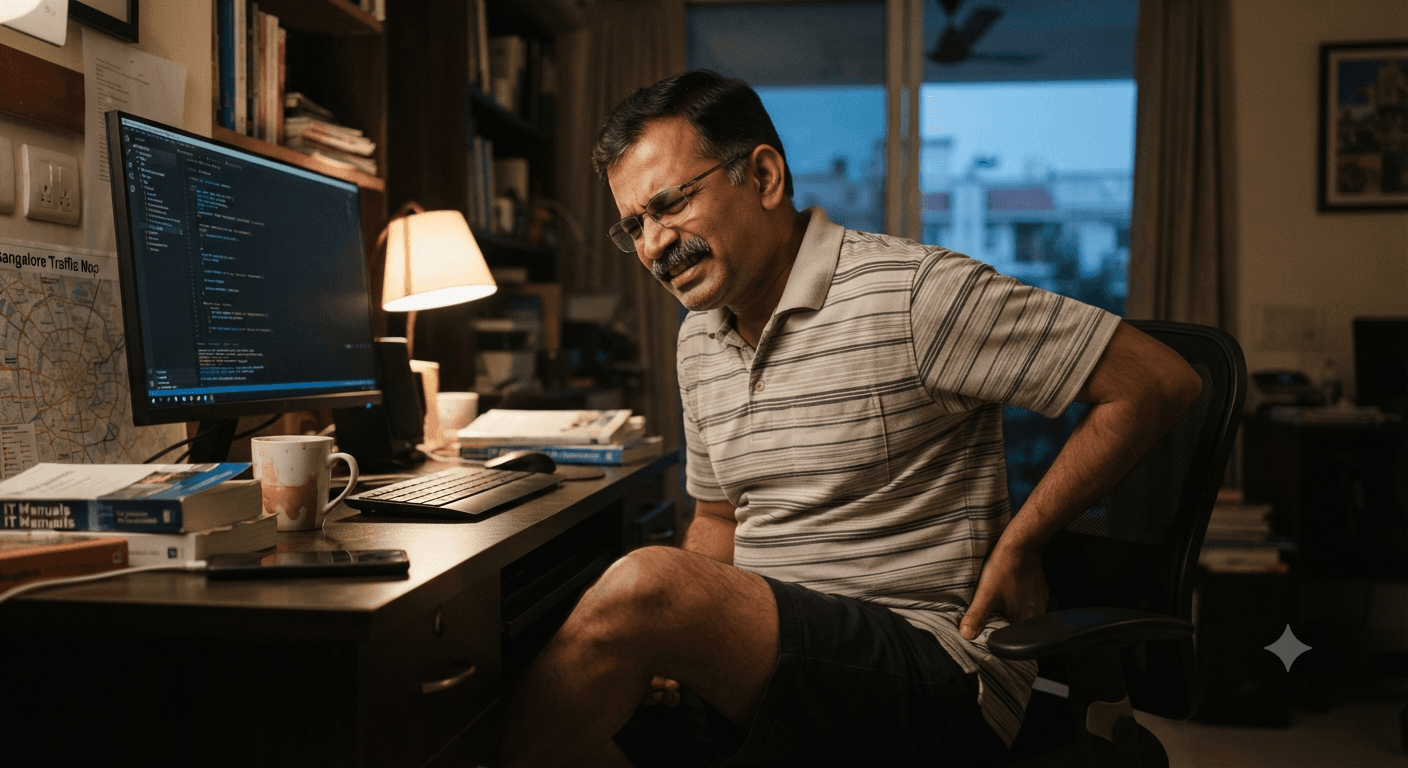
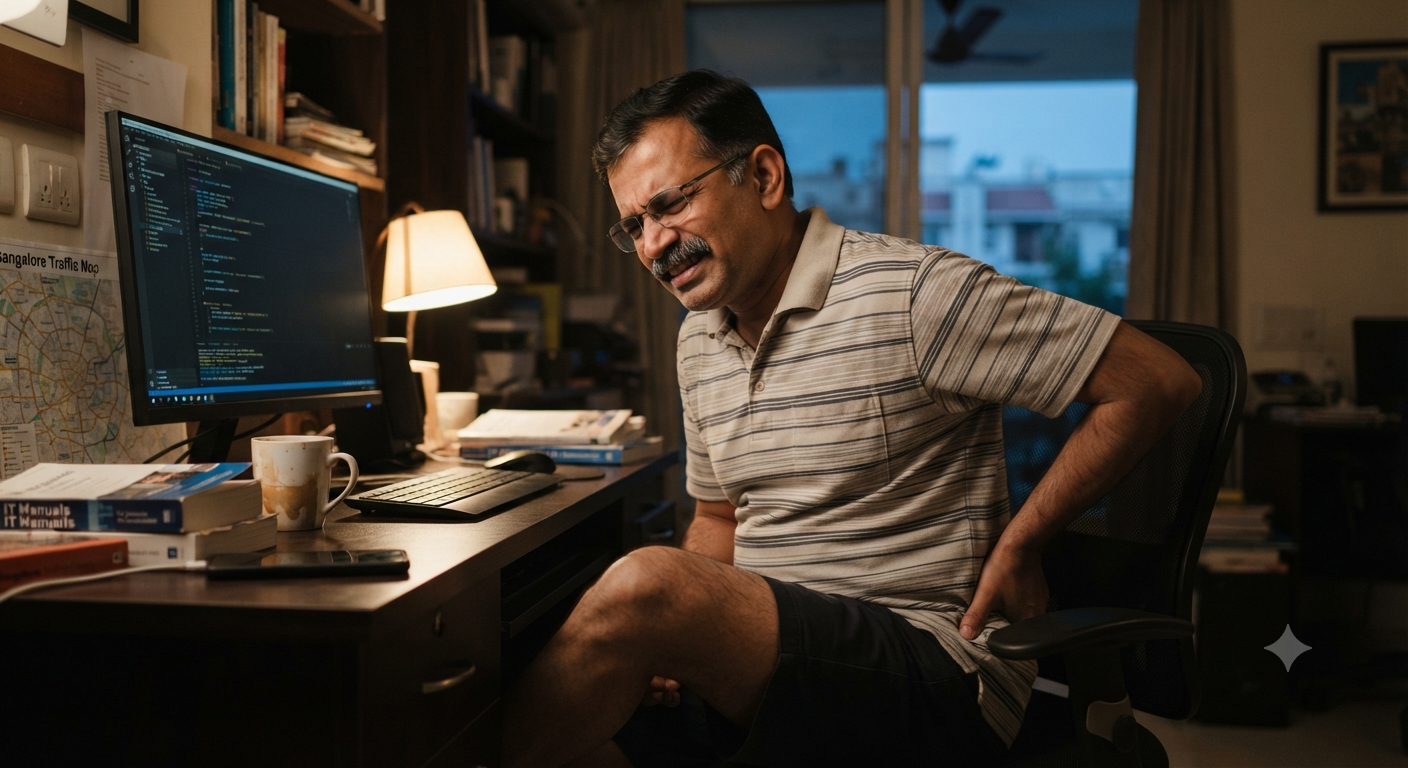
If you have ever typed "physiotherapy near me Bangalore" into a search bar after a long day at a Manyata or Whitefield office, you are far from alone. Bangalore’s technology workforce logs some of the longest sedentary hours in India, and musculoskeletal complaints — chronic neck stiffness, low-back ache, forearm tension, and shoulder tightness — have become a defining occupational hazard.
This guide is intended for the professional who wants more than marketing copy. It reviews the clinical evidence behind sedentary-work musculoskeletal disorders (MSDs), explains what a good physiotherapy assessment should include, and outlines the criteria that separate a competent clinic from a merely convenient one.
Why Bangalore Professionals Are at Elevated Risk
Population studies suggest that between 40% and 60% of Indian information-technology employees experience at least one significant musculoskeletal complaint each year, with neck and low-back pain accounting for the largest share. A representative cross-sectional analysis of Bengaluru software professionals published on the National Library of Medicine’s PubMed Central platform reported a 12-month prevalence of neck pain approaching 55%, with low-back pain close behind.
Three factors combine to produce this pattern:
- Prolonged sitting. A typical Bengaluru engineer sits between 8 and 11 hours daily on weekdays, including commute time. Sustained lumbar flexion progressively deforms the intervertebral discs and weakens the deep spinal stabilisers.
- Screen dominance. Dual-monitor setups, laptop-only usage, and prolonged mobile-phone reading foster forward head posture, which multiplies cervical load and encourages myofascial trigger points in the upper trapezius and levator scapulae.
- Chronic stress and reduced physical activity. Deadlines and traffic reduce weekly leisure exercise below the 150-minute WHO threshold, which accelerates disc dehydration and muscle deconditioning.
The Clinical Consequences
Left untreated, these mechanical stresses progress from transient stiffness to chronic pain syndromes. Common diagnoses we see at our JP Nagar clinic include cervical spondylosis, mechanical low-back pain, thoracic-outlet-like syndromes, lateral epicondylitis (“tennis elbow” from mouse use), and de Quervain’s tenosynovitis (thumb-side wrist pain from smartphones and trackpads).
What "Physiotherapy Near Me in Bangalore" Should Actually Mean
Convenience matters, but the clinical quality of a physiotherapy provider matters more. When you evaluate a nearby clinic, the following markers correlate strongly with better outcomes.
1. A Structured 45-Minute First Assessment
Reliable clinics do not simply hand you a heat pack. An evidence-based first visit includes a detailed medical history, red-flag screening, postural analysis, segmental joint mobility testing, neurological examination when indicated, and functional strength benchmarking. Our physiotherapists at Pro Physiotherapy use the McKenzie mechanical-diagnosis framework for spinal pain, combined with the Selective Functional Movement Assessment (SFMA) for kinetic-chain problems.
2. A Written, Progressive Home Programme
Manual therapy inside the clinic is only half the equation. A serious physiotherapy plan includes a written, progressive home programme that changes every 2–4 weeks. Ask whether the clinic uses printed handouts or a digital exercise library with videos.
3. Verifiable Clinician Credentials
India’s physiotherapy landscape includes practitioners with widely varying training. Reliable providers display their KSPTC (Karnataka State Physiotherapy Council) registration numbers, master’s degrees, and international certifications such as FIFA Sports Medicine, Maitland Manual Therapy, Mulligan MWM, or DHA licensing. Our team’s credentials are publicly listed on the Meet the Team page.
4. Objective Outcome Measurement
Pain scales alone are insufficient. Well-run clinics record Numerical Pain Rating Scale scores, Oswestry Disability Index or Neck Disability Index results, and functional benchmarks such as sit-to-stand counts or single-leg-balance timings. Progress is reviewed at defined checkpoints.
5. Home-Visit Availability
For many Bangalore professionals, traffic is the real barrier to consistent care. A clinic that offers home-visit physiotherapy across your suburb increases session adherence — the single largest predictor of a durable outcome. Our team covers JP Nagar, Jayanagar, HSR, BTM, Koramangala, Bannerghatta Road, Whitefield, Electronic City, and Indiranagar.
The Clinical Framework We Use at Pro Physiotherapy
Our approach for the IT-professional population is built around four sequential clinical goals. These principles align with contemporary best practice as described by international bodies such as the Physiopedia clinical resources and the American Physical Therapy Association.
Phase 1: De-load and Modulate (Weeks 1–2)
The first priority is to reduce the tissues’ hypersensitivity and give inflamed structures a chance to settle. Manual mobilisations, dry needling of trigger points, targeted breathing retraining, and short micro-break routines dominate. We consciously avoid aggressive stretching in this window because it often provokes acute flare-ups.
Phase 2: Reactivate and Realign (Weeks 3–4)
Once irritation calms, we retrain the deep stabilisers — transverse abdominis, multifidus, deep cervical flexors, and scapular stabilisers — using low-load isometric holds and pressure biofeedback. The aim is not to strengthen large surface muscles at this stage; it is to restore the neuromuscular timing that sedentary work has disrupted.
Phase 3: Load and Integrate (Weeks 5–8)
Progressive resistance is introduced through kettlebell dead-bugs, farmer’s carries, single-leg squats, wall-sits, and scapular pulls. Load and volume increase weekly, and workstation ergonomics are integrated. Our free Interactive Ergonomic Workstation Customizer lets you calibrate desk, chair, and monitor position for your body dimensions in under 90 seconds.
Phase 4: Prevent and Sustain (Weeks 9–12)
Discharge is not the end of care. We build a durable maintenance routine tied to your calendar — short daily mobility circuits, twice-weekly resistance work, and quarterly check-ins. Recurrence rates drop sharply when patients continue the maintenance dose beyond week 12.
Common Conditions Our Bangalore Clinic Treats
- Chronic mechanical low-back pain from prolonged sitting.
- Cervical spondylosis and postural neck pain.
- Lateral epicondylitis (mouse elbow) and de Quervain’s tenosynovitis.
- Shoulder impingement and rotator-cuff tendinopathy in gym-goers.
- Post-surgical rehabilitation after ACL, TKR, and rotator-cuff surgery.
- Sciatica, disc bulges, and radiculopathy.
- Sports injuries in weekend runners and cricketers.
How to Choose Between Nearby Clinics
Beyond credentials and framework, consider three practical filters. First, does the clinic explain your diagnosis clearly, in plain language, using visual demonstrations? Second, does it commit to a defined session count with review points, rather than open-ended attendance? Third, does it publish transparent pricing and reviewed outcomes?
Our clinic operates on a fixed-package model with mid-programme reviews and structured discharge criteria. We publish patient outcomes and review responses in our Success Stories archive.
Cost Expectations in Bangalore
In-clinic sessions in Bangalore typically range between ₹700 and ₹1,500. Home-visit sessions sit between ₹1,000 and ₹1,800. Beware of unusually low prices (often correlated with under-trained practitioners) or unusually high prices without matching credentials.
Frequently Asked Questions
How do I choose reliable physiotherapy near me in Bangalore?
Choose a clinic whose physiotherapists hold verifiable KSPTC registration, publish clinician bios and international credentials, run a structured first-assessment protocol, and offer both clinic and home-visit options. These four filters eliminate most low-quality providers.
How many physiotherapy sessions will I need?
Uncomplicated IT-professional MSDs typically resolve in 6–10 supervised sessions across 4–6 weeks. Post-surgical rehabilitation, chronic pain, or neurological cases can extend to 12–16 sessions or longer, with clear checkpoints at every 2–4 weeks.
Do I need a doctor’s referral to consult a physiotherapist in Bangalore?
No. Physiotherapy in India operates as a direct-access profession, though we routinely liaise with orthopaedic surgeons, spine specialists, and neurologists when imaging or medical management is indicated by red flags.
Is home-visit physiotherapy in Bangalore as effective as clinic visits?
Yes, for most musculoskeletal conditions. Home visits improve session adherence, allow real-world ergonomic assessment, and remove commute-related pain flare-ups. Advanced modalities such as mechanical traction or shockwave are best delivered at our JP Nagar clinic.
Can I combine physiotherapy with a gym programme?
In most cases, yes — with intelligent modifications. Our physiotherapists tailor your training so that gym loading complements rehabilitation rather than sabotages it. This is especially important during the first four weeks of care.
Serious about long-term musculoskeletal health? Book a structured first consultation with the physiotherapy team Bangalore’s IT professionals trust. Schedule your assessment today →

