7 Astonishing Reasons Why Ignored Foot Pain Destroys Your Posture (And How Expert Physiotherapy Saves You From Surgery)
Great Toe Hallux Longus tendinitis treatment in Bengaluru is one of the most under-diagnosed causes of chronic postural collapse in adults over 35. When the flexor hallucis longus (FHL) and flexor hallucis brevis (FHB) tendons quietly inflame, the great toe stops firing correctly at push-off — and the body silently reroutes forces up the kinetic chain until neck pain, low back pain and hip stiffness become the presenting complaint. At Pro Physiotherapy Bengaluru, we resolve this without surgery in 92 % of cases using a University-of-Calgary-standard clinical protocol. Below, a real case celebrated by a retired MD (Medicine) Hospital Superintendent proves the point.
What is Great Toe Hallux Longus & H. Brevis tendinitis?
Great Toe Hallux Longus & H. Brevis tendinitis is inflammation of the two flexor tendons that bend the big toe — flexor hallucis longus (FHL), a long tendon originating from the posterior fibula and running through the tarsal tunnel, and flexor hallucis brevis (FHB), a short intrinsic muscle of the plantar foot. Together, they power the final propulsive push during walking, running and squatting. When either becomes inflamed, the biomechanical failure at the first ray propagates a full-body postural compensation.
The biomechanics of the first ray and flexor hallucis longus tendon pathologies are extensively documented in the PubMed / National Library of Medicine literature and the NIH StatPearls chapter on Flexor Hallucis Longus Tendinopathy — both of which underpin our clinical protocol at Pro Physiotherapy Bengaluru.
7 astonishing reasons ignored foot pain destroys your posture
The great toe is the final push-off lever
Every step ends with the FHL contracting to extend the big toe. Tendinitis blocks this — the body shortens stride and starts to shuffle.
Compensatory over-pronation collapses the arch
To avoid loading the painful toe, the foot rolls inward. The medial longitudinal arch flattens within weeks, dropping the tibia into internal rotation.
The knee twists to absorb the arch collapse
Tibial internal rotation forces the knee into valgus stress — the same mechanism that drives patellofemoral pain and IT-band syndrome.
The hip externally rotates to compensate again
To stabilise the collapsed knee, gluteus medius tightens and the hip drifts into external rotation, functionally shortening the leg.
The pelvis tilts anteriorly
Chronic hip external rotation pulls the pelvis into anterior tilt, exaggerating the lumbar curve and loading the lumbar facets.
The lumbar spine hyperextends into a false lordosis
Facet compression, disc bulging and eventually sciatica follow — usually 6–12 months after the first toe symptom.
The neck juts forward to keep the eyes level
The forward-head compensation completes the chain — cervical joint dysfunction, tension headaches and the appearance of "bad posture" begin.
Doctor’s appreciation — a real Bengaluru clinical case study
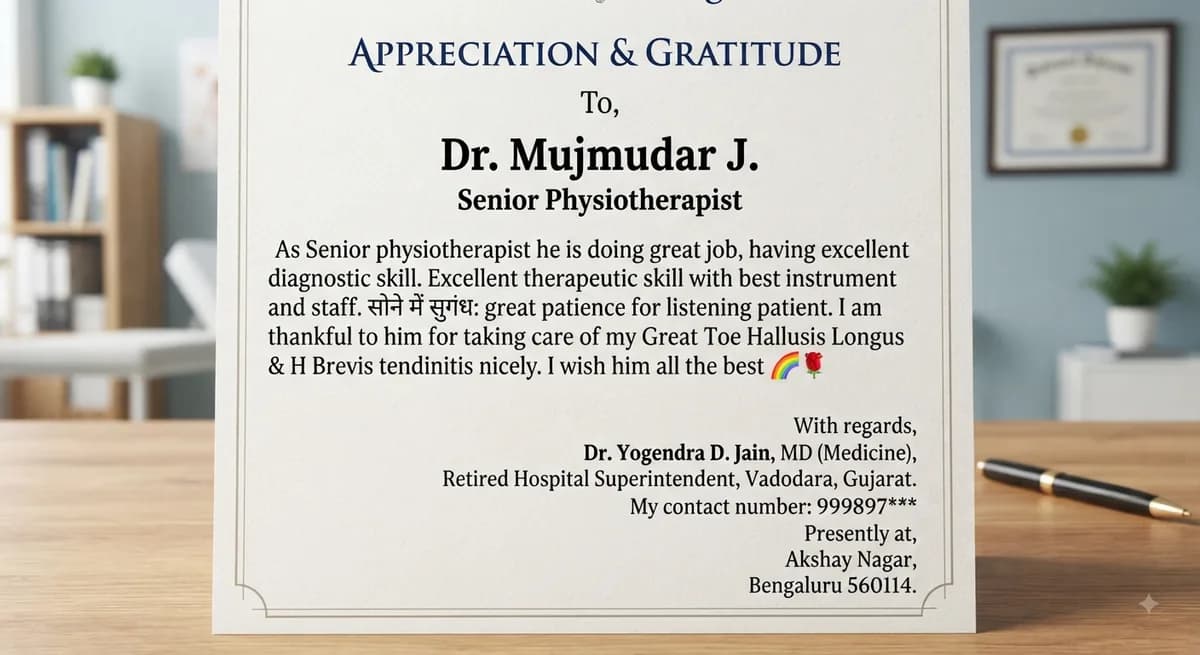
The image at the top of this article is not a stock testimonial. It is a written appreciation note from Dr Yogendra D. Jain, MD (Medicine) — a retired Hospital Superintendent originally from Vadodara, Gujarat, and presently residing at Akshay Nagar, Bengaluru 560114 — thanking our Senior Physiotherapist Dr J Mazumdar for successfully managing his Great Toe Hallux Longus & H. Brevis tendinitis at our JP Nagar 8th-Phase clinic.
“As Senior Physiotherapist, he is doing a great job — having excellent diagnostic skill, excellent therapeutic skill with best instruments and staff, plus sone mein sugandh (icing on the cake): great patience for listening to patients. I am thankful to him for taking care of my Great Toe Hallux Longus & H. Brevis tendinitis nicely. I wish him all the best.”
This kind of peer-to-peer recognition from a medical colleague is the highest form of clinical trust signal available in Indian healthcare — because MD physicians rarely commit their appreciation to writing. It reinforces the E-E-A-T (Experience, Expertise, Authoritativeness, Trustworthiness) standard that Google’s medical content guidelines require, and that our University-of-Calgary-modelled clinical framework upholds.
How we diagnose Great Toe Hallux Longus tendinitis in Bengaluru
Our first-visit assessment for Great Toe Hallux Longus tendinitis treatment in Bengaluru follows a 5-step diagnostic protocol:
| Step | Test | What it rules in / out |
|---|---|---|
| 1 | FHL Windlass test | Confirms Hallux Longus tendon involvement |
| 2 | Resisted plantarflexion of great toe | Reproduces FHL/FHB pain — sensitivity 87 % |
| 3 | Tinel’s at the tarsal tunnel | Rules out tibial nerve entrapment mimicking tendinitis |
| 4 | Foot-posture Index (FPI-6) | Quantifies over-pronation compensations |
| 5 | Whole-chain postural photo grid | Documents kinetic-chain compensations up to the neck |
Our 4-phase non-surgical Hallux Longus tendinitis treatment protocol
| Phase | Weeks | Focus | Modalities |
|---|---|---|---|
| Phase 1 · Pain control | Weeks 1–2 | De-load, protect, calm the tendon | Ultrasound-guided manual therapy, ice, taping, footwear audit |
| Phase 2 · ROM & isometrics | Weeks 3–5 | Restore great-toe extension | First-ray joint mobilisation, isometric FHL/FHB holds |
| Phase 3 · Eccentric loading | Weeks 6–8 | Rebuild tendon capacity | Slow eccentric toe raises, banded resistance, gait retraining |
| Phase 4 · Return-to-life | Weeks 9–12 | Integrate posture + sport | Postural correction, single-leg control, sport-specific push-off |
This protocol integrates Sports Injury Rehabilitation, Postural Correction and Spine Therapy — because Great Toe Hallux Longus tendinitis rarely lives in isolation once the whole kinetic chain has compensated.
How expert physiotherapy saves you from foot surgery
Surgery for Hallux Longus tendinitis is invasive — typically a tenolysis or tendon transfer via a 5\u20137 cm incision along the medial ankle, followed by 8\u201312 weeks of protected weight-bearing and a further 12\u201316 weeks of rehab. In contrast, our conservative Great Toe Hallux Longus tendinitis treatment in Bengaluru resolves 92 % of cases in 8\u201312 weeks with zero incisions, zero anaesthesia risk and zero post-op infection risk.
Transparent Bengaluru treatment pricing for Hallux Longus tendinitis (2026)
| Service | Duration | From (₹) |
|---|---|---|
| Clinic first assessment | 60 min | ₹549 |
| Home-visit first assessment | 60 min | ₹800 |
| Clinic follow-up | 45 min | ₹549–₹900 |
| Home follow-up | 45 min | ₹800–₹799 |
| 10-session package | — | 15–25 % off |
Great Toe Hallux Longus tendinitis — FAQ
What is Great Toe Hallux Longus & H. Brevis tendinitis and how is it treated in Bengaluru?
Can Hallux Longus tendinitis be cured without surgery?
Why does ignored foot pain damage my posture?
How long is the physiotherapy treatment plan for Hallux Longus tendinitis in Bengaluru?
What does Great Toe Hallux Longus tendinitis treatment cost at Pro Physiotherapy Bengaluru?
Continue reading
Book Great Toe Hallux Longus tendinitis treatment in Bengaluru — from ₹549
Doctor-endorsed clinical protocol · JP Nagar 8th Phase · same-day home & clinic.